Featured

For the Love of the Game

Everyone who has ever played rugby has felt the same familiar overwhelming brimming of anticipation and eagerness. A massive fixture lies tantalising in reach on the Saturday afternoon, but a full week of work is required first. A glance at the clock re-affirms that gameday is still some time away so all you can do is dream of being on the pitch, of scoring the winning try.

For most of us the pinnacle of this will manifest itself in a humble County Cup Final or maybe a local derby, when your opposite number is someone who loves to tease you about the result at your local pub for months afterwards.

However, in the West of Iberia, there was two men who fulfilled their modest 9-5 plagued with zealous thoughts of clashing with the famous Wallabies, two-times Champions of the World, and with Warren Gatland’s Wales, multiple Six Nations Grand Slam winners. For these few, a full-time occupation coincides with the mental and physical preparation necessary to compete, and win, at the very zenith of the sport.

Playing at the Everest of professional sport when they aren’t a fully professional player.

Portugal rugby’s now talismanic and beloved captain, Tomás Appleton, began studying to become a dentist in 2012, back then rugby was just a hobby and he, nor anyone else, could have foreseen what lay on the horizon.

We know now that the swash-buckling crash-ball inside centre, with silky soft hands to boot, would go on to announce himself on the world stage. However, for much of his life his silky soft hands have been on the inside the mouth of residents of Lisbon, dental hygiene his main focus.

Since becoming a qualified surgeon in 2018, Tomás has become used to balancing work and rugby, working long hours through the week to allow for time to travel and compete all over Europe with ‘O Lobo’ on his chest.

“Personally, I enjoy balancing work and rugby, it is a way I can split my mind between two worlds and escape from one or the other. I find it is good for my mental health.”

However, when the most unlikely of Rugby World Cup qualifications became a reality, everything changed, as a three-month leave, and a chance to live like a professional, was required.

“My work were understanding, they realised that the World Cup was a huge opportunity for me and for Portuguese rugby, an opportunity that I may not get again for a very long time, but it was still hard.
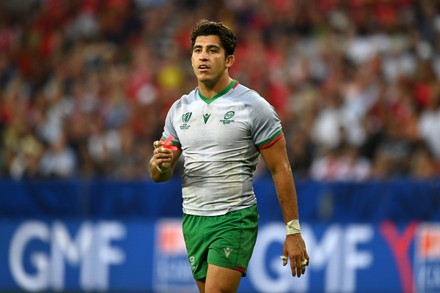
Tomás Appleton

“I noticed the difference in performances when we went full-time (before the World Cup). You can focus 100% on everything regarding rugby and you have no worries about anything else.”

Another player who took time off work to clash with the world’s best was Tomas’ Portugal teammate and Grupo Desportivo Direito flanker, João Granate.

João works for a swimming pool company as a project manager, lending his leadership and commanding presence on the field to managing the pool installers and producers.

“I’m lucky because my boss was a rugby player and is a rugby fan and so he is happy to give me flexible hours, but it is still a 9-5 job.

“It is very tough, balancing work and rugby but I got used to it during college, the teachers were very unhelpful and, for example, wouldn’t let me rearrange my exams when they coincided with rugby. If I missed an exam, I would have to do it again in the summer or the next year.

“In a work environment it is much more stressful because it is not your company. In college when I made mistakes, I was the one who paid for them, now if I make mistakes then other people are affected too. Some days are harder than others.

“It can get very stressful, you’re at work thinking about rugby and you are at rugby thinking about work.”

For the Portuguese players, the three-month period they had in France together was an eye-opening experience, not just for their exploits on the field but also for realising the joys of being a professional athlete, even just for a short period.

João said: “It was harder physically but mentally it takes a bit of steam off to know that you don’t have to be at work or call to say you will be late or hurry to practice and be told off by the coaches for being late.”

“During the European Rugby Championships, it is much harder because we practice during the middle of the day, so you have to tell your boss that you won’t be at work.”
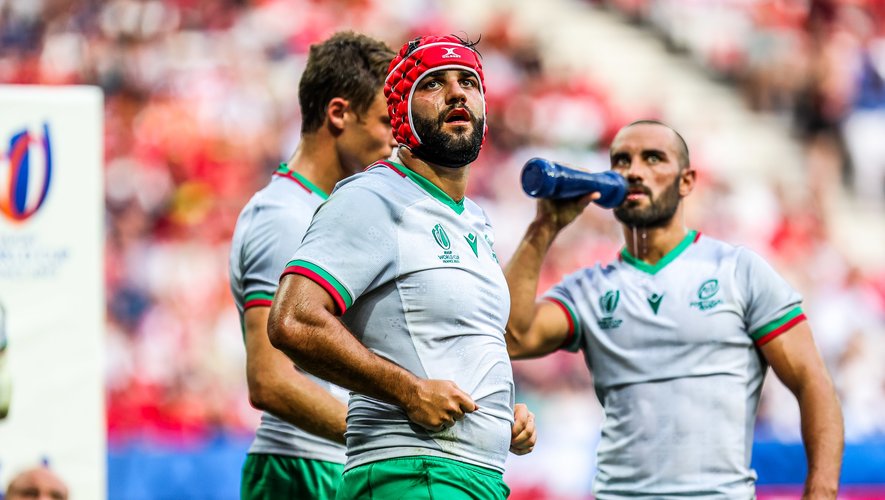
João Granate

“When you train hard and you can rest your mind, it is easier on your body and your mind, when you train hard and then you have to work and then train again, it is difficult.”

With this new lifestyle, Portugal thrived at Rugby World Cup 2023, beating Fiji, drawing with Georgia and testing the mettle of global rugby juggernauts, Australia and Wales.

When asked if they knew that they would compete with these global superstars on the field, or if they ever doubted their abilities, Joao answers confidently:

“When we qualified for the World Cup, we made it a goal of ours to compete and to not look at the opposition teams and players as above us.

“Not to disrespect any of the players but we knew that if we wanted to compete and win, we had to see them as beatable.

“A massive part of our preparation both mentally and physically was to be on their level. They had things we didn’t have, like World Cup experience, so we had to find an edge.”

“We would joke about certain players, ‘oh he’s good but I’m going to be better than him’”.

Tomás calmly and assertively corroborated this assessment, saying:

“Approaching the World Cup, we were realised our value and our potential, and we were pretty confident that we could compete.

“At the same time, we were not used to playing against top players, for most of us these were players that we usually watch on TV!”

So, what’s next for Portugal rugby’s courageous project manager and dentist duo? Both mention their hopes for a fully professional club division in Portugal and of course more games against ‘tier one’ nations on the world stage.

But what about quitting their day jobs and branching overseas to become bonified professional athletes?

João shows a wry smile at the thought, replying: “I am happy where I am now, but it is always in the back of my head – what if I was professional, where could I aspire to be? I do want to test my level and if there was a good project, I would be open to it.

“I am not doing everything I can to be a professional player because I have that experience alongside my career. But we know that at the World Cup we upped our level and so if I test myself, I do think about where it could go.

“I am open to it (playing rugby full-time), I would like to talk to some people to see if there is opportunities abroad but as of it, nothing has come up.”

His national captain and teammate, on the other hand, is much more coy, his cards firmly pressed to his chest: “At the moment I have a steady life and a balanced life here in Portugal, as a dentist and as a rugby player. I have been in contact with a few agents, some opportunities to play abroad might come in the future but I am not sure, we will see.”

Even after World Cup glory in front of tens of thousands baying supporters, the effortlessly humble João and Tomás, oozing with a quiet but subtle confidence, choose to remain as double-agents, hard-working employees through the week, national heroes come the weekend.

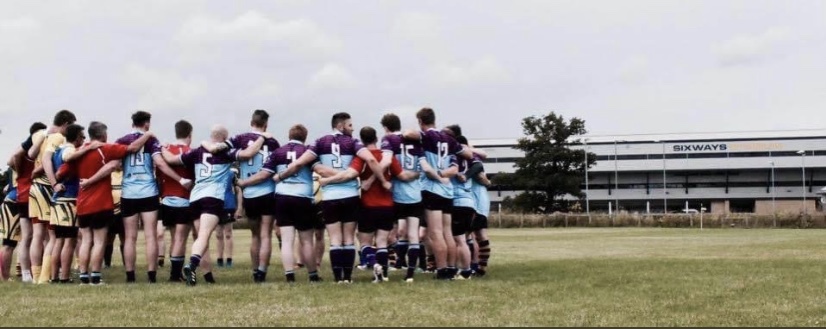
Featured

Why English Rugby is Unsustainable

The problems with England’s elite game and what needs to be done.

The Ancient Greek myth of Icarus highlights the dangers of extreme hubris and arrogance. It features a young and foolish boy who begins the story as a proud and virtuous man but is corrupted when handed excessive power.

Icarus is overcome and giddy with excitement when his father gifts him wings with which to fly. His father gives him a single stern warning, do not fly too close to the sun, else you will lose it all. Nonetheless, overwhelmed with eagerness and complacency, Icarus disobeys and flies as high as he possibly can, too close to the sun, his wings set on fire, and he is killed.

In a funny way, English rugby is not unlike the mythical Icarus, handed the freedom and opportunity of professionalism, it has failed to acknowledge the obvious and ominous signs of its trajectory and finds itself dangerously close to the sun’s orbit – on the brink of oblivion.

English rugby is a baby when compared to its sporting rivals. Football became professional in 1885, 138 years ago, cricket in the 1960s, around 60 years ago, while rugby has had a measly 28 years of professionalism. If the life span of professional football was the average human life of 80 years, then rugby would be a spotty, confused 16-year-old, adapting to its new voice and sudden fondness for girls.

As put by MP for Ashford Damian Green in the DCMS report on English rugby union: “Is it possible that the attempt to turn club rugby into a professional game in this country ran before it could walk? Things got too ambitious, and people have spent too much money. Are we trying to support an infrastructure that there just isn’t enough demand for, that there is not enough TV revenue, not enough gate revenue, not enough of all the ancillary revenues to support the kind of institutions we have set up?”

This year, two Premiership clubs, Worcester Warriors and Wasps, have already been forced into administration and the rest are barely afloat, as shown through their annual reports. Most surviving solely on revenue streams from the international game and from their owners plunging excessive funds into the clubs, forcing them further and further into debt.

The team crowned English champions a matter of months ago, Leicester Tigers, required a bailout payment from shareholders of £13m to avoid the possibility of urgent alternate funding or administration. With Tigers consistently one of the league-leaders in attendance, and therefore gate revenue, this news spelled grim and ominous reading for fans of all clubs.

A brief look at the Companies House documents for the eleven remaining Premiership shows the daunting severity of the situation. Clubs such as Saracens and Harlequins have made respectable turnover, £21m and £27m respectively, but only three teams in the last two seasons have reported a post-tax profit or broken even and Saracens and Exeter losing over £5m each in 2021 is clearly an unsustainable business model.

Club:Financial Loss/Profit 2022 (after tax)Financial Loss/profit 2021 (after tax)  Turnover  Wage Expenditure
Bath   -£0.1m-£0.3m£19.8m£10.6m
Bristol   -£3.3m-£3.5m£14.2m£9.9m
Exeter   -£1.2m-£6.3m£20.2m£12.1m
Gloucester    -£0.6m+£0.1m£17m£10.5m
Harlequins   -£1.5m+£0.5m£27m£12.3m
Northampton   -£0.1m-£0.3m£20.8m£10.7m
Newcastle     N/A+£3.5m£8.9m*£7.4m*
London Irish      N/A-£3.9m£8.6m*£8.4m*
Sale    -£3.3m-£1.5m£12.2m£9.6m
Saracens    -£4.9m-£5.3m£21.4m£12.6m
*= 2021

If the financial fragility of the current Premiership clubs isn’t ominous enough, the fact that over 25% (4/14) of clubs that have been in the Premiership in the last 15 years have gone into administration, and not returned, should bring home the gravity of this desperate situation.

ClubYears in PremiershipWhere are they now?
Bristol Bears2008-2009, 2017, 2019-2023Current Premiership club
Bath2008-2023Current Premiership club
Exeter Chiefs2011-2023Current Premiership club
Gloucester2008-2023Current Premiership Club
Harlequins2008-2023Current Premiership club
Newcastle Falcons2008-2012, 2014-2019, 2021-2023Current Premiership club
Leicester Tigers2008-2023Current Premiership club
Leeds Carnegie2008, 2010-2011Went bust, Tier 3
London Irish2008-2016, 2018, 2020-2023Current Premiership club
London Welsh2013, 2015Went bust, Tier 5
London Wasps2008-2022Went bust, Tier 2
Sale Sharks2008-2023Current Premiership club
Saracens2008-2020, 2022-2023Current Premiership club
Worcester Warriors2008-2010, 2012-2014, 2016-2022Went bust, future unknown

Published PhD researcher and senior lecturer in Sport’s Business, Andy Golding, wrote a report on the business sustainability of professional Rugby Union in which he stated: “Professional rugby seems unable to grasp the basis of any business, which is to generate revenues to cover costs, not to build a cost base and then try to generate revenues to cover them”.

Asked to elaborate this point, Andy highlights the lack of direction of Premiership owners to create revenue streams before budgeting large, professional scale projects.

“A lot of people approach owning a rugby club as philanthropic exercise and it seems that any principles of business that would apply outside the ecosphere of professional rugby get thrown out the window.

“Things like ground-shares, sharing a ground with another club, are not profitable, you have to own your stadium to be profitable because you can make money hosting hospitality and networking events.

“It is a simple principle of business that you have to have the money coming in to cover costs, which doesn’t apply in rugby.”

The other main issue Andy highlights is the lack of alignment between Premiership clubs and between the clubs, and PRL, and the RFU. On this point, Andy celebrates plans for an English independent framework, similar to the Ligue Nationale de Rugby in France, but insists more has to be done.

“Owners in the Premiership have differing objectives, say one club wants to avoid relegation and one wants to finish in top four, those objectives show in their ownership models.

“The RFU governs the amateur game and operates from an amateur ethos while PRL operates from a professional business ethos and often the objectives aren’t the same. There is constant conflict between club and country, and they don’t share the same objectives.

“You need an independent framework which checks and balances both bodies and ensures sustainability.

“There is little proactive thought, much of what is done is reactive, but as we have seen it may be too late.”

Kieran Maguire, an expert in football finances and author of the book, ‘The Price of Football’, helped compare the billion-pound money churner which is association football, with the wilting debt-machine which is English rugby.

“What rugby has, is a growing cost base, but limits in increasing its scope in the three pillars of revenue, ticket sales, broadcast deals and commercial partners.

“The inability to control costs is the challenge for the game. Especially for a game which is struggling for column inches at the club level.

“The Premier League is watched by 188 nations around the world, it is global; how many different nations watch Gallagher Premiership rugby? A handful?

“If I am a ultra-net worth individual and I want people around the world to know who I am, I will buy a Premier League club; look at Newcastle United, their new owners exchanged a relatively low amount of money for them, for a huge amount of attention.

“Rugby doesn’t have that recognition, that kudos.

“There needs to be a culture change. It only takes a few owners who think they can buy their way to success, to set about an ‘arms race’.

“Once they start spending more than they have then other clubs will be forced to do the same or risk losing all their players.

“Some owners can afford for their clubs to lose a lot of money and some can’t, which creates tension in the sport. Unless the owners vote collectively for draconian cost-cutting processes, I don’t see things changing.”

So before English clubs race for the next Kiwi or Saffa import, eyes glazed over with greed and gagging to exchange hundred-pound notes for a brief taste of glory. And before the RFU announce their next million-pound profit turnover while another club slips into the abyss and the Championship rots in the limbo of semi-professionalism.

They should remember the cautionary tale of Icarus. The man who was overambitious and greedy. The man who was given everything he could have ever wanted and lost it all.

Featured

The Death of West Midlands rugby?

The effects of Worcester’s demise on the West Midlands, and how the region can recover.

The West Midlands is famous for many things, they were the inventors of Range Rovers, Cadbury’s, and the birthplace of the Balti curry.

It is also the birthplace of rugby, named after the town in Warwickshire where, as the old story goes, a schoolboy named William Webb Ellis allegedly picked up a football and began to run with it, in that moment inventing a sport that would go on to span hundreds of years and over a hundred nations.

So, it would stand to reason that the birthplace of the great sport would remain a powerhouse and fierce breeding ground of English rugby.

Well no.

If you discount Wasps who moved to Coventry in 2014, the sole professional representative of rugby in the West Midlands was Worcester Warriors. A team proudly built by the generous philanthropy of proud Worcestershirian Cecil Duckworth, who flew the West Mids banner for 13 seasons of Premiership rugby before being tragically plunged into administration last October and their future as a semi-pro club very much unknown.

(Click for full timeline)

For months Worcester was a rudder-less ship heading for disaster at an increasingly alarming pace.

Like the Titanic in 1912, thought to be unsinkable, but nonetheless one iceberg away from total ruin. The warning signs of total collapse were frequent from the start of the pre-season of 2022/23.

As described by former Worcester prop and Scotland international, Murray McCallum:

“Bailiffs turned up to take the Watt Bikes because we hadn’t paid the Watt Bike bill.

“We came in for pre-season and we didn’t have some medical supplies and I thought- oh right here we go then.”

Murray describes the moment that a group of 18-20-year-old academy players were made homeless, without warning, when the mortgage was defaulted on the academy housing that the club paid for.

“One lad was sat on the couch having a nap on his day off and some bloke walked in and dangled the keys in front of his face and said- just so you know I’ve just bought this house, I think the club are going to speak to you tomorrow.”

A number of factors can be attributed to the demise at Worcester, the COVID pandemic and the debt it ensued was the nail in the coffin, the metaphorical iceberg, but unluckily for Worcester, the captains of the ship were less than capable of maintaining course.

When asked if there is resentment between himself and former owners, Colin Goldring and Jason Whittingham, Murray replies in a split second:

“Massive, massive resentment.

“It was the lack of communication and the constant feeling that they didn’t really care. They never tried to message us, to tell us their side of the story. It was like they didn’t think they did anything wrong.

“There was a final court proceeding over Zoom that they didn’t even turn up to, it was a 24-second Zoom call and that was it, we were in administration.

“We found out on Twitter because that is where we got all our information at the time.

“The owners didn’t want to speak to us and told us nothing and they got annoyed at us for posting on Twitter.

“We were so in the dark; we didn’t know who to trust.”

Forced into unemployment in the middle of the season, they were left with nothing but memories of a final win at Newcastle, when staff ran the stadium and gameday procedures for free, knowing they wouldn’t be paid.

“We knew Newcastle would be our last game. We voted on whether we would play, we said we would play if two-thirds voted for it and 75% voted to play.

“At 10.30am on Wednesday the 5th of October, I was sat in my Mum’s conservatory. I read it on Twitter and then the boys in the WhatsApp group confirmed it- that’s it lads, we’re dust.”

The legacy of Worcester’s demise is not just bared by their former staff, however, they leave behind them the region of communities who were nurtured and supported by the club.

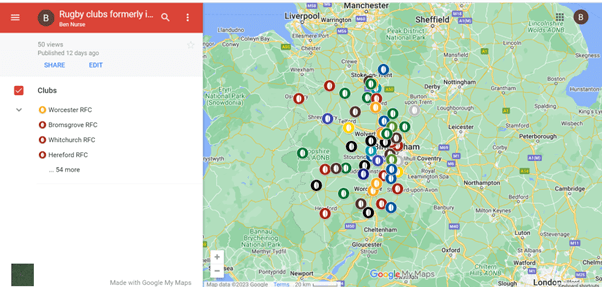
(Click for full interactive map)

Some 200 metres over the road from the towering Sixways arena is local community club, Worcester RFC, who play amateur rugby in Tier six.

Tom Reeves, a Welshman turned adopted Worcestershirian, is Worcester RFC’S PR and Comms Officer and Head Coach of the Mixed Ability Team.

He is well versed in what rugby clubs can mean to people, as a member of the Worcester RFC family.

“It is a hive of activity; we have a thriving mini and juniors section, on Sundays its packed with kids eating hotdogs and tracking mud in the clubhouse.

“It is primarily a place to come and chew the fat and escape the worries of the world; it is a safety net and an extra family.”

For Tom and the rest of Worcester RFC, a big factor in the loss of Worcester Warriors is the many benefits of the overspill of fans on a Premiership matchday, eager to use the carpark and obtain food and refreshments.

“We’ve predicted £20,000-£25,000 lost revenue, per season. We’ve really had to look at ourselves and come together as a group of volunteers and find ways to plug that hole.

“As a community, it has ripped a lot of soul out of the area. There is a lot of annoyance around here and there is no one taking responsibility, everyone has just washed their hands with the issue.

“You can’t just pack up a rugby club and go and support another one. It is not just what we do on a Saturday, it is our support network, we care about what happens on the pitch but what is more important is the guy sat next to you every week, that you banter with and share a pie.”

Luckily, it seems the legacy of Warriors next-door-neighbours will far outlive that of the former Premiership Cup Champions.

As per Merton’s Law of Unintended Consequences, Warriors’ demise has contributed to a drastic uptake in attendance at Worcester RFC, as frustrated former fans try desperately to fill the large rugby-shaped hole in their hearts.

“We’ve had more people at men’s and women’s games; we had about 200 at an u21s game last week, it was packed.

“We are bucking the trend in rugby at the moment, and we are growing.”

A message, perhaps. That while elite professional rugby in the West Midlands is, for the time being dead, community rugby in the region is alive and kicking.

Regardless of the Premiership and its strife, there will always be a local club near you full of friendly faces where, as Tom puts it, “you can chew the fat and share some banter and pie and forget the worries of the world.”

After all, William Webb Ellis all those years ago at Rugby School had no intention of contracts or stadiums when he invented the sport we love, just a game with a ball and some friends.

Featured

A Day in the Life of a Travelling Reserve- As told by Will Cliff

In Greek mythology Sisyphus was a former King of Corinth who dreamed of being immortal, he would frequently attempt to trick the Greek Gods and coerce them into awarding him his wish of never dying.

As punishment for his crimes, Sisyphus was sentenced with rolling a boulder up a hill in Tartarus, over and over again, for eternity. Each time Sisyphus completed his task and hauled the boulder to the top of the hill it would roll back down, restarting his task. Sisyphus was granted his wish of immortality, but in the process was condemned with a brutal infinity of scrupulous and monotonous repetition. Over time the fable of Sisyphus became a philosophical metaphor for human nihilism, put simply, continually doing something difficult for no reason and for no real gain.

Some 4000 years later and across the continent in Manchester, Will Cliff is not too unlike Sisyphus as he laces his boots before Sale Sharks fixture against Saracens.

Will has played over 200 games for Sale Sharks but today he is a travelling reserve and will warm-up with the squad in case of a last-minute injury but barring this eventuality, will not play in the match. Just like the former King of Corinth rolling his boulder to the top of the hill, only for it to roll down again, Will’s hard work today will not see his name written across the headlines of tomorrow’s back page.

It is not impossible, of course, for a last-minute injury to occur. In 2017 Harlequins player-coach Adam Jones was preparing for a cushy afternoon in the coaches box before Joe Marler tweaked his calf in the warmup, forcing Jones to rush to hurriedly change into playing kit to take his place on the bench, eventually playing 20 minutes in a 29-26 win.

So, what does a day look like for a ‘TR’, as they are known in the business.

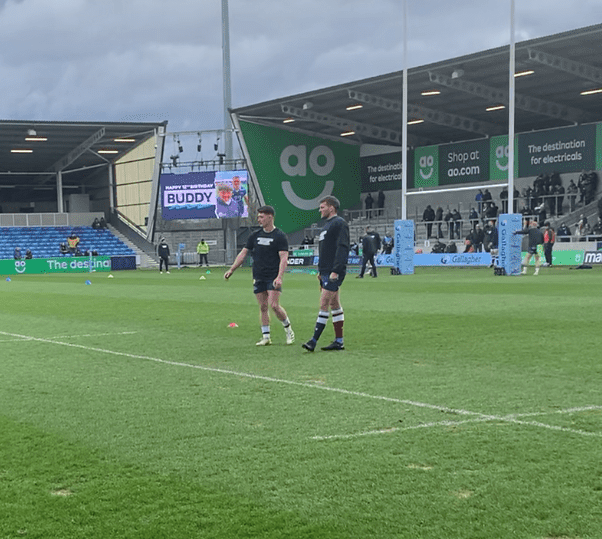
2.30pm: Warmup

“You go through all the same build-up as the guys who are playing, but you probably aren’t as focused, you’re probably a level below.

“But as soon as you’ve got your kit on and you start warming up, you’re fully focused because now your job is to help prepare the guys who are playing.

“In that moment it is no different to if you are playing.

“It is after the warmup when the rest of the lads go in and you stay out to do some extra fitness and it hits you that you aren’t playing because everyone has made it through the warmup.

“Eventually you head back in and you see the mascots all lined up ready and the fans are buzzing and the flags are waving and that’s the point where you go – ‘I’d love to be playing, I wish it was me running out today’”.

Will now takes his place on the bench alongside the other TRs, separate from the substitutes to watch the first half. Despite having the best seats in the house, he can’t shake the burning feeling that every professional sportsperson has when they watch their team play a big game without them.

Is there a small part of him that wishes Gus Warr or Raffi Quirke had got a knock in the warmup so he could step into the team?

“No there actually isn’t. When I was younger and I was chomping at the bit- yes, and it has happened before to me.

“These days, obviously I really want to play, but there’s no part of me that’s thinking ‘I hope someone goes down here’ simply because I am less prepared than they are.

“In the week I know I’ll be a TR so I’ve been running around as a Saracens player, so I’m not as prepared on the detail of our plays.

“The night before you do everything you should, you eat your pre-match meal and you get an early night, but you know in your head you’re not as prepared as you could be.

“If someone had fallen out, I would have sat for the whole first half catching up on our plays, but it is not ideal.”

3.45pm: Half-time

While the crowd simmers and slowly disperses for a quick toilet, beer and hot dog detour and fans are invited on the field for a half-time kicking contest, the TRs make their lonely trudge round the field.

With a lack of coaches, who are inside grilling the playing 23, there is a visible lethargy with which the TRs complete their customary kick and pass drills.

Will puts up a bomb kick for fellow TR Byron McGuigan as a wry cackle ripples around the crowd due to a particularly poor and comical effort at winning an LED TV in the kicking contest.

4.45pm: Full-time

Sale run out rampant 35-22 victors over the league-leaders, the baying audience maintain their volume as the players lap up the love in their post-match lap of honour.

Will goes with them and smiles as he catches up with old friends on the partition between player and fan.

But it is not the same, he describes, as if you had starred in the spectacle, if you had scored the winning try or simply put your 100% into pushing the team over the line.

That is the life of a TR, a constant slightly diluted, watered downed taste in your mouth, when you really want the full flavour experience. Doing the work for little reward.

However, those of the philosophical persuasion will know that the story of Sisyphus is not one of tragedy or despair. In 1942 the French philosopher Camu wrote an interpretation in which Sisyphus beat the Gods by finding a sick, sadistic pleasure in his task, realising he had no other choice.

Just as Will finds pleasure in ensuring Gus Warr is fully prepared for a hard fixture.

“Especially for someone like me who’s had a long career, you feel responsible for making sure the younger lads are 100%, as fully prepared as they can be.

“Before every game I’ll work with the other nines and I’m there for whatever they need. I’ll put pressure on their kicks I’ll kick for them to catch.

“The lads will be well prepared but if you see something as the game starts to unfold, you’ll tap one of the boys on the back and tell them ‘There’s space in the back left corner, or that opposition nine is slow on his box-kick you can charge him down’.

“You have to take some pride in helping them be ready.”

Featured

Neuroscience and ‘Rainy Day’ chats – Alex Sanderson on Toulouse week

Alex Sanderson is known for his open, honest and blunt nature. In his own words, Steve Borthwick tells him nothing because, “he knows my mouth is like a tap”. But off the back of a stirring win over Harlequins and days away from a game against Toulouse, with the opportunity to avenge one of the toughest loss of the season, Alex spoke with particular raw candour.

Another open truth about Alex is that he is a fierce advocate for conquering the mental aspects of elite sport. He revealed his friendship with Bill Beswick, a psychologist and former coach at Manchester United, among other clubs, turned author.

He said: “I am proud to say he is one of my mentors, and I read his book, ‘The Intangibles’.

“He stated the neurological truth that at home games your testosterone is raised by an average of 5%, and that’s seen in work-rate, aggression, drive.

“So, if you’re wondering, are the players going to put on a performance? They will and that is science-fact, not just a feeling. They are up for it and in front of a packed house, and a little bit burned from what happened in Toulouse a few weeks ago.”

A compelling fact when you consider Sale have only lost once at home this season, to Harlequins in November. A fact that Toulouse are no doubt aware of.

Speaking on Toulouse, Alex described the advantage of a return fixture at home, now with a firm grasp and understanding of how the opposition play.

He said: “People don’t realise how fast they are to strike, and they are unbelievable opportunists.

“If you give them a sniff then you’re in the tumble dryer, just chasing shadows. They got us on a quick tap and on a few other occasions, when we weren’t alive to it, now we are.

“40% of their tries are off first phase, and 76% off the first three phases, which shows the nature of their attack, it is only really Quins and Gloucester, in the Premiership, at a push, that can strike that fast and play with that level of unpredictability.”

A big challenge for Alex and the team this week will be transitioning from the high of beating Harlequins in London, and the magnitude of effort and focus that must have taken, to shift the focus to the five-time European Champions, with just a short six-day turnaround.

When asked about Harlequins, Alex spoke about the many ‘learnings’ that he and the rest of his coaching team took from the game.

He said: “The part of the game I was most impressed by was when Quins scored just after halftime. When you’re under the sticks again, in those crucial moments, it’s about being calm and composed and clarity of message and going back to the plan.

“To not think you need to chase the game and do something different as an individual but to go back to working as a collective. Because we were in a similar situation against Toulouse, and we conceded again soon after.

“So that composure we showed Sunday, that we didn’t show three weeks before, that is one of those learnings that we want to take into this week.”

It is an exciting time for Sale on and off the field; with the high-flying performances of the team attracting interest from myriads of media outlets endeavouring to crack the code and tell the secrets of the extraordinary run of form. Filming has taken place at Carrington for the last few weeks for a ‘fly-on-the-wall’ documentary, mirroring the likes of ‘Drive to Survive’, the exponentially popular Netflix series focused on Formula One.

One of the many steps that are being taken to improve the product on and off the field.

When asked if he is worried about spilling the secret ingredient to success in the documentary Alex confidently replied: “Knowledge is knowledge and by the time it gets aired we will be on to the new thing.

“We are creating something special, we have some really good characters around this place. And if you create something unique and a bit different, which is has to be if you want to create something special, then that message should be shared.”

Another string to Alex’s bow is his sophisticated man-management. He cares profoundly in developing relationships and having an acute understanding of what makes people tick and in turn, understanding how to get them to peak performance.

After arriving as Director of Rugby two years ago Alex has got to know two of the biggest characters at Carrington very well, Tom and Ben Curry.

He said: “The misconception is that you talk to them as a collective, but they are very different people. They have their own motivational drivers and their own X-Factors.

“It starts with trust and with a rapport, you have to find out who they are as individuals. You have conversations at the pressure points of the season, ‘rainy day’ conversations, as we call them, when things aren’t going your way, that is when you find out who they really are.

“They do rely on each other a little, but they’re their own people, they deserve individual time and attention.

“They do play better together because there is love there and love breeds oxytocin which drives you harder and for longer.

“It is funny really, I can tell the difference now in their characteristics and mannerisms that make them so obviously different, but at the start it was purely a haircut.”

On the note of individuality, Alex was full of praise for how Ben and Tom have advanced their skillsets to become more versatile and well-rounded in their own rights.

He said: “In rugby terms, Ben used to have a point of difference with ball in hand in attack, while Tom was maybe more physical and breakdown-orientated.

“What we’ve seen over the last 6 months is them coming together in playing style. Tom has the ball in his hands more and Ben has manned-up physically, he wins turnovers and belts people defensively. So, where there was perceived difference, they are far more aligned.”

Alex wrapped his press conference by contemplating a question on whether has become more comfortable in the role of Director of Rugby in the last 24 months. Hesitating at first, Alex laughed and explained why.

He said: “There is things that I find less stressful, but I don’t know about ‘comfortable’ because every week something comes up, a curve-ball that you have never seen before. Every time you think you have a hold on things life finds a way to say, ‘no you truly don’t’.

“But I look forward to it now, in a slightly sadistic way.”

Featured

Ranking the 10 best Premiership signings of 2022

https://record.revmasters.com/_LKUn9zI7CY2h_7RUBh20pWNd7ZgqdRLk/1/

With the dust still settling on an historic seventh Premiership title for Leicester Tigers all eyes are turned upon the challenge of the new season, a chance for glory and consolidation for some and a chance for redemption for many others.

After arguably the most erratic and headline-grabbing year of player movements the Premiership has ever seen, there will be many of the biggest stars donning new colours and potentially creating new dynasties. The heart of that title-winning Leicester team has already been poached through the loss of stars such as George Ford and Ellis Genge however they will hope their own new signings can keep them at the head of the pack.

I compiled this list based on my own personal opinion of which players will have the biggest impact on their respective new clubs. Therefore, teams that performed well last season will suffer because they have little room for improvement, whereas, teams that underperformed, such as Bristol and Sale, rank higher because they are expected to improve because of their signings.

Honourable Mentions:

Albert Tuisue will add some serious aggression and intensity to Gloucester’s already extremely physical pack and could well give them the push they need to secure a Top 4 finish. Niall Annett is an extremely underrated player who will likely cement himself as Bath’s starting hooker next season. Recently crowned Premiership champion, Matias Moroni, is another underrated player who will add a new dimension to Newcastle’s attack. While many would have expected Anthony Watson to be on this top 10 list only time will tell whether his move to Leicester is worth his wage bill considering his fitness problems and possible England commitments.

10. Tom O’Flaherty -> Sale Sharks

Speaking of underrated players, few fly lower under the preverbal radar than Tom O’Flaherty. An English and Welsh qualified winger, O’Flaherty is consistently at the top of the metres made and defenders beaten charts and punches significantly above his weight for his 5’9 stature. He is not only strong but also one of the fastest players in the league and notably efficient under the high-ball. Exeter Chiefs will be gutted to lose the elusive winger, he has been integral to their recent success, starting in their famous 2020 Champions Cup Final win over Racing. He will be a regular starter for Sale and will be vital for them as they look to expand and develop on their attacking structure which was dull and blunt in 2021-22. O’Flaherty was third in the entire league for metres made last season with 1773 and eleventh in the entire league for defender’s beaten with 60.

Defenders BeatenMetres MadeTries ScoredClean Breaks
Tom O’Flaherty (2021-22)601773m513

9. Magnus Bradbury -> Bristol Bears

The 18-time capped Scottish international is an extremely shrewd signing by the usually unsubtle Bristol Bears. The Number 8 is a hard-worker who is very explosive and fast for his size and, significantly, is comfortable playing across the back row so will strengthen an area where the Bears are weak after the loss of Nathan Hughes and with talisman Steven Luatua going on his 32nd birthday. The makeup of the Bears backrow next season will be extremely interesting with Bradbury, Luatua, Harding and Jeffries all being fluidly interchangeable between the 6,7 and 8 jerseys and all extremely mobile and skillful. Bradbury, however, will add some much needed physicality to Bristol who, at times last season, were guilty of overplaying and too often looking for a miracle play when structure and game-management were necessary. Bradbury had a successful 2021-22 with Edinburgh, finishing with the fourth best tackle success rate across the whole league with 98% from 101 tackles made. He was also tenth for turnovers won with 14 and seventh for carries made with 158.

Tackles MadeTackle SuccessCarriesTurnovers Won
Magnus Bradbury (2021-22)10198%15814

8. Danilo Fischetti -> London Irish

While it would be naïve to suggest that Irish are carried by their backs and are let down by their forwards, you could say that they are one or two forwards away from being a regular top 4 team, and Fischetti may well be one. The prop has 20 caps for Italy at just 24 years of age and had a very impressive 2022 Six Nations campaign. He is dynamic and deceivingly powerful and has the potential to be a regular starter for Italy for years to come. Irish have good depth at loosehead prop with Will Goodrich-Clarke and Facundo Gigena but expect Fischetti to be in the matchday 23 every week that he is available. The Italian perfectly suits the Irish style of play with his nice balance of brawn and heads-up rugby nous.

Tackles MadeTackle SuccessCarriesTurnovers Won
Danilo Fischetti (2021-22)7996%552

7. Lukhan Salakai-Loto -> Northampton Saints

The 25 cap Wallaby will fit into the Saints DNA seamlessly with his ability to slide between lock and blindside flanker, not too dissimilar from current Saints stars Courtney Lawes and Alex Coles. Salakai-Loto is in the beneficial position of not being in the current Wallabies setup despite arguably entering his playing prime, meaning he is available to Saints for more games, adding to his value to the team. The Lawes and Salakai-Loto comparisons do not end at their versaility, Lukhan is a devastating blend of raw power and freakish athleticism and speed for his size, eerily reminiscent of the England captain. His carrying is to an elite standard and his soft hands lend to his value as a solid lineout option. The Wallaby did not play many games last season for the Reds due to injury however over an impressive nine seasons of Super Rugby he played a total of 69 games, scoring 4 tries. He will be a good replacement for the departing Api Ratuniyarawa, a very underrated piece of the Saints team the last few years.

6. Hugh Tizard -> Saracens

More than a few eyebrows were raised when Harlequins allowed Hugh Tizard to leave for arch-rivals Saracens. The Quins academy product had a thoroughly impressive breakthrough season in 2021-22 and looked like one of the best locks in the league for long periods, and at just 22 years of age. I would personally suggest that he will go onto to be a 50 cap England international and it could be said that but for his injury, he would be on the plane to Australia this summer for England’s summer tour. Tizard will have staunch competition for places at Saracens with Maro Itoje and Nick Isiekwe in the mix, however, Tim Swinson’s retirement should assure him a regular place in the matchday 23. The lock made 168 carries last season for 785 metres made, an average of 4.7 metres per carry. He also had a 89% tackle success rate from 240 tackles made. Saracens, known for their shrewd signings, really have secured a nugget of gold with this one.

Tackles MadeTackle SuccesTriesCarriesMetres Made
Hugh Tizard (2021-22)24089%3168785

https://record.revmasters.com/_LKUn9zI7CY3BkgpoV0de5mNd7ZgqdRLk/1/

5. Handre Pollard -> Leicester Tigers

Possibly lower than many of you reading this may have expected. The World Cup winner will miss a fair portion of the start of the season through the Rugby Championship and when he returns, will have a fight on his hands to dethrone the impressive Freddie Burns for the 10 shirt. Add to this that he has consistently struggled with injury problems and spent much of last season on the bench for Montpellier behind Paulo Garbisi. Despite all this Handre is obviously one of the best fly half’s in the business. A consummate professional and meticulous tactician, Pollard did not get his World Cup winners medal for nothing and Leicester certainly do not hand out big money for any old player. He will have big shoes to fill replacing George Ford who was arguably Tigers best player last season on the way to their title, however, Pollard is well suited to the Tigers kick-heavy, possession-less style of tactical rugby and will no doubt excel in the English Midlands.

4. AJ MacGinty -> Bristol Bears

Controversial above the World Cup winner, purely because I think overall he will add more value to his respective team. A slightly confusing signing when it was first announced considering Bristol have Wales international fly half Callum Sheedy. However, I can see how both can work in tandem in dual-first-receiver roles with one possibly playing at 15 or 12 or coming off the bench and with both possibly missing time for internationals. AJ may be the stronger of the two 10s so I would expect him to start. Despite a quiet end to his final season at Sale, AJ had an extremely impressive time in Manchester, infinitely multiplying his market value and reputation after moving from Connacht in 2016. The American international played 108 times over 6 seasons for Sale scoring 878 points including 9 tries and you could see the value he added to the team especially in the games when he did not feature. He is extremely well-rounded, causing headaches for defences because he is equally effective distributing the ball through his short and long passing and kicking and as a running threat. His vision and knowledge of the game is at the very top level, as is his goalkicking which rarely waivers below 85% on average. AJ has the potential to be the best 10 in the league on his day.

Metres MadeTry AssistsPointsClean BreaksDefenders Beaten
AJ MacGinty (2021-22)4324110619

3. Vincent Koch -> Wasps

Another World Cup winner and Springbok stalwart, Wasps have bagged a gem with the 28-time capped tighthead. Wasps have been weak at tighthead for a few years and will lose Jeff Toomaga-Allen next season, however, Biyi Alo has somewhat emerged this season as a potential England tighthead, meaning they now have good competition there. Koch is elite in just about every area around the park, he is a strong carrier, a brick wall in defence and one of the best scrummaging tightheads in the world. Koch played 109 times over 6 seasons for Saracens and can boast a staggering array of trophies, winning the Premiership twice and Champions Cup twice and being integral in every campaign. Koch’s experience and consistency will be vital for what is a young and inexperienced Wasps squad looking to build from being a underperforming, inconsistent, mid-table back to the regular top 4 threats that they once were.

CarriesMetres MadeMetres Per CarryTackles MadeTackle Success
Vincent Koch (2021-2279421m5.3m22294%

2. Ellis Genge -> Bristol Bears

The 36-time England international needs no introduction or hype and his Bristolian homecoming has been well documented. An extroverted and controversial character off the field, his confidence is more than matched by his consistent performances on the pitch. He has already cemented himself as one of the best loose heads in the world and the firm owner of the England number 1 shirt and, scarily, is still improving. Leicester’s decision to make him club captain last season, although controversial at the time, turned about to be inspired as he flourished as a natural and inspirational leader and was overall a great gesture by the club for a man who gave his all every week during his tenure. There is no doubt that he will continue to improve at Bristol and will re-affirm himself as a strong leader in the South West. Bristol, as previously mentioned, crave direction and game-management which come from experienced leaders like Genge and his blend of power and dynamic intensity will nicely compliment Bristol’s style of free flowing rugby. I would be very surprised if Bristol do not return to the top 6 of English rugby next season.

CarriesMetres MadeMetres Per CarryDefenders BeatenTackles Made
Ellis Genge (2021-22)132687m 5.2m35111
  1. George Ford -> Sale Sharks

Unequivocally the single best player in the Premiership last season, Ford was instrumental in Tigers Premiership title last season, steering the ship like a captain at sea. Sale will have to overhaul and re-design their attack next season after an underwhelming 2021-22 campaign and no doubt the game plan will be scrupulously designed and detailed around the Manchester-native Ford. Unlike MacGinty, Ford prefers not to run the ball unless the opportunity presents itself to him, preferring to invited his teammates onto the ball, inviting them into gaps in the defence with his razor-sharp vision. His kicking game is devastating and unpicked numerous teams last season. He can find space in the backfield effortlessly and his bombs give opposition fullbacks nightmares the night before gameday. On form he is the current best 10 in England, however, Eddie Jones preferring Marcus Smith and Owen Farrell just adds to his value, meaning he can devote all his time and effort to Sale’s Premiership effort. Although he will miss the start of next season with the injury he sustained in the Premiership final, Ford has immense effect on every game he plays in and does so much to influence winning. He finished this last season with the most points of anyone in the Premiership with 220 and picked up two Player of the Month awards. You can read my analysis on how Ford will change the Sharks here:

Try AssistsKicks From HandMetres MadeMetres Per CarryDefenders Beaten
George Ford (2021-22)7250349m5.8m13

I hope you agree with my list, if you do not agree be sure to tweet me @bennurse8 and tell me why.

Click here

Featured

Why the Six Nations coverage is an embarrassment to year-round rugby fans

The problems with rugby media and questions of meritocracy.

There are many things which make the Six Nations Championship great. The rivalry, the passion, the competition. Rugby fans all over the world look forward to the annual showcase and rumours about changes to the format will remain speculation for the foreseeable future. Rugby’s higher-ups wouldn’t dare tinker with their prize tournament.

However, just like any good thing in this world, with the good comes the bad, and the Six Nations is no exception. Year-round rugby fans would be lying if they said that the annual influx of casual fans was not tedious and recently the heated rivalry, that we all so desperately love, has become slightly too heated, especially on social media. But for me the crux of the issues with the Six Nations is the media.

Year-round rugby fans will be familiar with the ever-improving BT Sport coverage of Premiership and European rugby, which is both inclusive and detailed in its portrayal of the weekend’s rugby, continuing to be a thoroughly enjoyable experience and the flagship for rugby coverage. The characters on BT are a wonderful balance between likeable personalities and meticulously knowledgably rugby brains with Monye, Kay, Flatman and, dare I say, Healy, breaking down the game we love in a signature entertaining and comprehensive style. Furthermore, although I am not a regular consumer, Amazon Prime, Premier Sports, RTE, S4C and Stan are all great options for rugby viewing.

The BBC and ITV coverage is in direct contrast of this experience. The pundits are boring, and the commentators are frazzled and neither of them really know anything about rugby. This is nothing new, “jobs for the boys” and the nostalgia-ridden hiring process of former players has been in rugby, and all sports, for years. However, the aforementioned Monye, Kay, Flatman and Healy are all also former players and happen to also be brilliant rugby-minds.

The problem with these characters is that despite being great players and coaches in their day, they simply don’t understand the modern game at all. Instead of bringing in people who genuinely understand the complexities of the game, the BBC and ITV choose to have these has-beens pretend to know what they are talking about.

What is worse about these characters is that many of them are not only ignorant to new developments but they seem to have a phobia of them, frequently criticizing new laws or tactics that would make themselves even more outdated than they already are. Furthermore, they clearly have no intentions to actually engage with the fans who are watching or contribute to topical debates, something that BT do so well.

It should not be needed to be said that if you do not pay attention to a craft for 15 years + that you are not an expert in this field anymore. I achieved an A in my Maths GCSE but less than five years later I can confidently say that I have forgotten all of it.

Furthermore, rugby is not set in stone, the game is fluid and there are not definitive ways of doing things. The game changes faster and faster all the time and modern progressions and evolutions are making the game unrecognisable to the game played in the early 2000s. Add to this technological advances which increase the circulation of information and statistics and I believe it is safe to assume that modern coaches know far more about the game of rugby than their noughties counterparts.

Maybe it is just me, but this years’ soap opera was particularly tedious and hard to listen to, you couldn’t count on two hands how many times the commentators completely got a players name wrong, an unforgivable sin on the international, test stage. The comical combo of Butler and Jiffy, both Welshmen, were particularly hard to listen to with their tournament highlights including: “Gareth Biggar”, “Ross Harris”, “Johnny Nicol”, “Willis Halahola” and my personal favourite, “Monty Eye-Oh-Knee”, Not to mention Jiffy’s painfully over-simplified recommendation for Wales to “pick and go” and proceed to use the word ‘lateral’ over 10 times in one game.

If it is your job to comment on 46 men playing a game then it is the bare minimum of professionalism and courtesy to learn to say the player’s names correctly.

Meanwhile, the studio teams managed to repeatedly speak for 30 minutes after every game without actually making a single coherent or interesting point throughout the whole tournament. This could be forgiven if the coverage wasn’t intensely bias, despite this year showcasing one of the most exciting Italian teams of all time, I don’t think a single Italian player was mentioned in the analysis through the whole tournament, one can only assume the ‘analysts’ in the studio didn’t know any of their names.

To put it extremely bluntly, there are 15-year-olds who know more about rugby than these ‘pundits’ and it has become tedious to the point where it is almost a running joke. I can no longer watch a Six Nations game without cringing or being embarrassed for the game that this is the best we have to offer in our flagship tournament.

An even more confusing element to this narrative is that the BBC and ITV continue to ignore the genuinely knowledgeable an interesting former professionals. Ugo Monye and Maggie Alphonsi are very intelligent and articulate pundits who have both previously been employed by BBC or ITV and who were dropped for this years Six Nations coverage, Monye taking a backseat role on the highlights show.

You only have to look at the BBC Sport rugby homepage and you will see a who’s-who’s of 2003 World Cup Winners and 1990s coaches with opinions that match the years of their primes.

When I complain about this issue the usual retort is that because the Six Nations brings a significant viewership of casual fans, the coverage needs to be dumbed down to help the new and less knowledgeable fans understand the game.

No wonder the game doesn’t grow if we choose to dumb down and simplify the game for casual fans. This not only alienates the year-round fans but also will not interest new fans who will never know the nuances and delicacies of the test game. Surely no one can truly believe that Clive Woodward’s nonsensical ramblings are more interesting and appealing for new fans than a detailed Squidge Rugby analyst video.

Speaking of Squidge Rugby (Robbie Owen), he is probably the best case study we have for a real knowledgeable fan subverting tradition and breaking into the mainstream having written for BBC Sport an appeared on Scrum V. Why mainstream outlets do not pursue Robbie and other talented rugby minds to make content for them I do not know. A common retort is that it does not get viewership because casual fans don’t understand it. Well how the hell do we know that if we haven’t tried anything different from the same thing we have been doing for 40 years? I think I speak for the whole rugby community when I say we are proud of you Robbie and we want to see more.

https://www.bbc.co.uk/sport/av/rugby-union/51747412

While we are on the topic of people living off their previous career. Influential rugby journalist and 2021 rugby journalist of the year nominee, Stephen Jones, was in the news this week for demanding Eddie Jones, the coach who has been to three of the last five World Cup finals, be sacked and replaced by Clive Woodward, who hasn’t coached international rugby for over 17 years. I will let you form your own opinion about that. As a general rule of thumb, any ‘journalists’ who demand that coaches be sacked are not worth your time, simply because clearly they do not have anything interesting to write about.

My head was spun this week by a tweet in response to a tweet about this very subject, “It’s when you realise that writing professionally isn’t remotely a meritocracy.”

As I previously mentioned, nepotism and “jobs for the boys” is nothing new in rugby, but the idea that rugby media is not a meritocracy is a slightly more unsettling concept. Particularly for those in the industry or aspiring to be so, like myself, it is a disheartening thought that our hard work could never be rewarded simply because we didn’t play the game internationally in the 1990s and instead these over-the-hill “run it straight” merchants will get all the good gigs at the top level.

The popular media platform JOE uploaded a video this week which really exposed how backwards rugby is and what a tiny place it currently holds in the sphere of global sports. The video in question involved asking ‘rugby fans’ what they would take from the game of football into rugby. Football is the biggest sport in the world and the only true global sport, raking in billions of profits in multiple countries. However, these are rugby fans and so sure as day various Schoeffel and brogue-clad private school alumni stepped up and spouted the usual nonsense about how football is beneath them with one even completely committing to the tired stereotype by using the line which makes every real rugby fan cringe and cower in embarrassment “football is a gentleman’s game played by hooligans and rugby is a hooligans game played by gentlemen”. (He has clearly never watched Bakkies Botha, Peter O’Mahony or Israel Folau play). I could write another article on this topic so will keep my views short, but it is this snooty superiority complex which means that rugby doesn’t grow as a sport. Rugby is in no position to look down on other sports and currently has a severe image problem.

The intention of this article is not to incite a revolutionary overhaul of rugby media, more to criticize it. However, I feel it is my duty as a responsible journalist to offer some resolutions and alternatives to accompany my criticisms. Rugby media is in fact not all bad, lower down the tree there are many shining lights that display the beautiful sides of rugby.

The aforementioned Squidge Rugby makes consistently quality YouTube videos which show the analysis required and used at the top level of test rugby, but in a fun and easy to understand format.

Sam Larner makes extremely interesting Twitter threads breaking down individual moves and passages of play as well as his popular series, Whiteboard Rugby which explains complex laws and rugby nuances with just a whiteboard and a pen.

Murray Kinsella and the team at The42 make fantastic rugby content while Charlie Morgan at The Telegraph is one of the best rugby analysts in the community

The team at WalesOnline including Simon Thomas make extremely intellectual and engaging Welsh-themed content.

Other interesting characters on YouTube include TwoCents rugby who spends copious amounts of time researching to ensure that he understands the game and can comment with complete responsibility and impartiality. More than can be said for many of the pundits at the highest level.

To conclude, despite there being shining lights and silver linings to the mindless drivel that is mainstream rugby media such as BT and the popular social media creators who uphold our integrity and sanity as a rugby community. The annual coverage of the Six Nations continues to be an embarrassment and cringeworthy experience for hardcore fans. I beg anyone with any power or influence to take a step out of the dark ages and employ someone who knows about rugby past 2005 because we as rugby fans, certainly deserve better.

Featured

Why AJ MacGinty is the Best 10 in the Premiership

Alan Leon MacGinty is a Dublin born, American international, fly half. After only playing a total of 502 Premiership minutes last season AJ has experienced a rugby renaissance of sorts and already has 772 Premiership minutes so far this season after just 11 games and has nailed down the 10 shirt. Despite his mercurial form this season, I don’t think anyone would consider AJ the best fly half in the Premiership, but this is because the nuance and style of MacGinty’s game can often go over people’s heads. The intention of this article isn’t to play down the ability of any other 10 but to appreciate the ability of AJ and maybe convince everyone reading this that he is the best 10 in the Premiership.

Role

To understand why AJ is so good you must first understand how modern rugby attacks function. Successful rugby teams will have one dominant halfback and one non-dominant halfback, simply so that one of them can control the pattern of the attack and manage the attacking options. Think of a kitchen, you can’t have two head chefs because this would create conflict and confusion, one of them must have ultimate control to create the best end product. For example, in the France attack, Antione Dupont is the dominant halfback while Ntamack and Jalibert are the non-dominant half backs however in the Scotland attack Finn Russell is the dominant half back and Price is the non-dominant half back. You want to give the ‘stronger’ of your two half backs more control so that they make the correct decisions. Once you understand this you must then understand that modern rugby teams either play off 9 or off 10. Teams that play off 9 play a tight, forward-orientated game that is designed to wear down defenders (e.g. Exeter) while teams that play off 10 play a more wider game designed to engage more defenders and create gaps (e.g. Bristol). How does this relate to AJ? Well Sale play with Faf De Klerk as the dominant half back and AJ as the non-dominant half back and they also play off 9 more than any other club in the Premiership with 63% of ball off 9 (2nd is Leicester with 62%) and against Bristol in February this stat peaked at 87% off 9 which is insane. This means that for every 100 passes Faf De Klerk made, less than 13 of them went to AJ. Therefore, AJ has to be more efficient than any other 10 in the league because he consistently has less possession and chances with the ball. In addition, Sale’s forward orientated game plan means that Sale rarely spread the ball into the wide channels and prefer to play tight amongst the forwards when they get a try scoring opportunity. I feel safe in the assumption that in a game plan more directed towards attacking in the wide channels, and with more control, AJ could thrive and double his attacking stats.

Playmaking

AJ excels at creating chances out of nothing, he often receives the ball off a tip on from a forward pod well behind the gain line and is superb in deciding whether to distribute or to dummy and carry the ball for metres. He reminds me of George Ford in that he appears to play in slow motion when he is making decisions and is always calm and composed in possession. In the Premiership AJ is more efficient than any other international 10, in 2020 AJ made 48 carries for 169 metres, an average gain of 3.5m, while George Ford had an avergae gain of 1.7m, Dan Biggar had an average gain of 2.2m, Owen Farrell 1.4m and Callum Sheedy 2.4m. What this stat is essentially saying is that when AJ decides to run rather than pass, this is the correct decision because he makes metres on these runs consistently. Furthermore, AJ is clinical in how he finishes try scoring opportunities, he is excellent in reading the defence and calling for the ball when a chance is on, this has been seen recently through Luke James’ winning try vs Bristol when AJ makes a late run to the blindside when he sees Sale have numbers, calls for the ball, and fires a miss pass to an unmarked James (note that Cliff was the 9 at this point). This season AJ has 51 carries and 6 try assists and 1 try, that’s a conversion rate of 14%. Compare this to teams that play similar game plans to Sale, Bath and Exeter, and Priestland has a rate of 4% and Joe Simmonds has a rate of 5%. In this stat, AJ only trails Smith, Sheedy and Umaga who play for teams that play predominantly off 10 and score far more tries. Also important to note that those three play inside supreme finishers such as Marchant, Green, Radradra, Morahan, Naulago, Bassett and Kibirige while AJ has played the majority of this season without Van Rensburg, Solomona or Mcguigan and so has been assisting the likes of Doherty, Roebuck and Reed with far less finishing pedigree.

Kicking

A Twitter account called “Goal kicker PLUS Rankings” has created a formula which combines goalkicking success percentage with average kick difficulty to create a metric called ‘value added’. Up to round 12 this season AJ is 5th in kicking percentage in the Premiership with 84% however he is joint 3rd in value added with Sopoaga and only behind Smith and Priestland. Furthermore, AJ has taken the 2nd most kicks at goal of any player which gives him more margin for error and therefore makes him more consistent than even these stats portray. AJ being in the top 3 10s for goalkicking is significant because, while Smith does, Priestland does not offer the same quality of play making that AJ can offer. Add to this that AJ has a top tier kicking game from hand and has an uncanny ability to recognise when there is space in the oppositions backfield and find the corners with kicks. In fact, according to OptaJonny on Twitter, AJ is 2nd in the whole league (Simmonds 1st) in kick retention with 28% from his 38 kicks retained. This means that AJ not only kicks into the right areas but his technique in hanging the ball and accuracy in finding his chasers is the some of the best in the league.

To conclude it cannot be argued that AJ is one of the most well rounded fly half’s in the league as he competes with Smith in play making, Priestland in goal kicking and Simmonds in kicking from hand. You may or may not agree with the title of this article which is fine, the important thing is that you recognise the ability that AJ has showed in recent weeks and how talented and accurate non dominant fly half’s have to be.

Credit for stats go to: RugbyPass, ESPN, Goal kicker PLUS, OptaJonny and BT Sport.

Featured

Rugby’s Roots- How Colonialism Shaped Rugby

Have you ever wondered why the Rugby World Cup and the IRB World Rankings are occupied by tiny Pacific Island nations and world sporting minnows such as Samoa, Tonga, Fiji and Namibia and yet world superpowers and sporting powerhouses such as Spain, Germany, Brazil and China are completely absent? Everyone knows the story of Rugby schoolboy William Webb-Ellis picking up the football and running with it in 1823 but what fascinates me is what happened afterwards, how did rugby go from Rugby to Buenos Aires, to Toronto, to Tokyo and to Tbilisi and become the cultural presence and geographical mismatch that we see today.

The most common way rugby was spread was through colonialism. Simply put, British ex-pats introduced the game to members of the British Empire while living there. This can be seen transparently today as 12 of the 20 top teams in the rugby world rankings were part of the British empire including dominant nations such as Australia, New Zealand and the USA. However, the most interesting example is Fiji, one of the most miscellaneous and arbitrary nations to the untrained eye but familiar to the common rugby fan and a dominant force in world rugby. Fiji are not only one of the few countries in the world to not have a national football team, they also only have one Olympic medal in their history, a gold one, in Rugby Sevens. So is it that Fijian’s don’t like other sports? No, it is simply that they weren’t exposed to other sports. Rugby was first played in Fiji in 1884 by British soldiers stationed on Viti Levu Island at the Native Constabulary at Ba when they noticed how genetically perfect the Fijian soldiers were for the physicality and pace of the new game. After that rugby took off on the pacific island, initially it was just played by Fijian soldiers and British ex-pats but soon a Fijian Rugby National Governing Body was formed and they played their first international vs Samoa in 1925 which kicked off at 7am so that the players had enough time to shower and change and be in work on time and the field also had a giant tree on the halfway line. Today Fiji are 11th in the rugby world rankings with recent competitive victories over Wales, Scotland, France and Italy and they dominate the Sevens circuit with 3 series wins in its 20-year existence. A similar story occurred in Namibia where rugby was introduced due to British and allied victory in World War One when the British commonwealth nation South Africa took control of Namibia which had been a German colony.

However, rugby wasn’t just spread through colonialism, Uruguay recently broke into the top 20 of the rugby world rankings and competed in the last two Rugby World Cups and they were introduced to the game by Christian missionaries from the UK who came to enforce religion. Furthermore, the Eastern European country of Georgia adopted rugby because it was so similar to the traditional Georgian game of ‘Lelo’ in which men of rival towns competed to carry a ball over a large field into the opposing team’s creek, hence why the nickname of the Georgian rugby team today is the ‘Lelos’.   

To conclude, if you asked an average person, say a football fan, to find Fiji or Namibia on a map they would undoubtedly fail, they probably wouldn’t even know that Samoa and Tonga even exist, however a common rugby fan could find Fiji on a map, tell you it’s capital city and tell you the names of 20 famous Fijian’s. There is a native Fijian in almost every major tier one rugby nation with England’s recent examples including Joe Cokanasiga, Nathan Hughes and Semesa Rokodunguni while Fijian’s litter every major rugby league with around 34 in France’s Top 14 in 2017 and over 20 in the English Premiership including this summer’s big money signings of Semi Radrada and Nemani Nadolo. How many Fijian’s play football in the English Premiership? I don’t think you need me to tell you it’s 0. In summary Fijian’s are core blocks that hold together the world of rugby, not just Fijian’s but also Samoan’s, Tongan’s and New Zealander’s and none of this would have happened if a British colonist hadn’t one day passed them a rugby ball (and yet the Kiwi’s, Aussies and Saffa’s still have the cheek to beat us at every World Cup). Rugby today is defined by those early Victorian colonies and without them maybe rugby might have never left the shores of England.

Featured

The Stuart Hogg Paradox

Stuart Hogg is the current Scotland captain with 20 tries in 76 international caps as well as two British and Irish Lions tours and two Six Nations player of the tournament awards. However, he has never been the unarguable best player in the world in his position and unless things change in the closing years of his career he will not go down in history as one of the world’s greatest fullbacks; in this article I will underline the reasons why.

The first main reason that Stuart Hogg’s legacy will forever be mired is down to his country of heritage, in other words, the fact he plays for Scotland. Throughout Stuart Hogg’s career Scotland have been an average to disappointing Six Nations side with a wooden spoon title, two 5th place finishes and having never finished above 3rd. Furthermore, during Hogg’s tenure Scotland have never broken into the top 5 in the IRB world rankings and haven’t advanced further than the World Cup quarter finals with a group stage exit to boot. This mediocrity has served to continually dampen and undermine the stunning individual performances of Hogg who seems to nearly always score great tries or have man of the match performances in losing efforts, in the two years he won Six Nations player of the tournament Scotland finished 4th. This raises the question, can a player truly be great, a legend, on a poor team? The question has been raised in relation to Italian Sergio Parisse for years and doesn’t seem to have a clear answer however off the top of your head think of the most well-known and obvious rugby legends in history; Jonny Wilkinson, Dan Carter, Richie Mccaw, Martin Johnson, George Gregan, John Smit, what do all these players have in common? They are all World Cup winners of course. After all, personal accolades create respect but team accolades create legacy. It can be argued that Hogg will never be recognised as a true great of the game because of the fact he played for a mostly poor Scotland side however i believe that Hogg performs far better when he is the leader and the shining light of a poor team when the system and the game plan is tailored to his style of play and he has the freedom to play as such. Furthermore, there is evidence that Hogg does not perform in teams full of stars when he is not the leader or the main offensive outlet and thus has less freedom. This is the Stuart Hogg paradox; he will never be recognised as a true legend just playing for average teams but when he plays in good teams full of stars he can’t perform as well. Which brings us to the tragedy that is his British and Irish Lions career. The 2013 tour to Australia came too early for a young 20-year-old Hogg well before his peak and he played 5 warm up games failing to make a test team but when the 2017 tour came around Hogg was in his peak and the nailed on starting fullback for the majority of fans and pundits alike. In a cruel twist of fate Hogg had an underwhelming first game and a half before being injured by an accidental stray elbow from team mate Connor Murray instantly ending his tour and his chance to prove himself on the big stage in a star studded team. Hogg himself must have realised this strain on his legacy as after 9 years at an average Glasgow Warriors team that he led and was the shining light for for many years (granted he won one Pro 12 title) he moved to English champions Exeter this past summer to play with other stars such as Henry Slade, Nic White and Sam Simmonds and to compete for titles in England and Europe. However, he has struggled to reciprocate his Glasgow and Scotland form for the Chiefs this season only showing glimpses of his class and in another cruel twist of the fate the season was postponed/ cancelled with Exeter in the top spot poised to go to the final and probably win another premiership. It is possible that Hogg could have gone on to have a man of the match performance in the final which probably would have put to bed the doubts of his quality but sadly not yet, we will have to wait.

If you are still sceptical simply think back to all of Scotland’s best performances and biggest wins in recent years; the narrow loss to Australia in the 2015 World Cup quarter final, the 2017 summer and autumn tour wins over Australia, the destruction of England in the 2018 Six Nations and the following 38-38 comeback draw with England, Hogg was quiet by his standards in all of these games. What else do all of these games have in common? Finn Russell was immense and ran all of the games. When Scotland run their game through Russell Scotland win, or at least play very well, and Hogg steps to the background. Russell is someone known for performing under pressure, it seemingly doesn’t affect him, look at his recent performances under the bright lights of Racing Metro’s ‘Paris La Defense Arena’, is it possible that Hogg can’t perform under pressure, even wilts underneath it? And he only plays well when the pressure is off and his team is losing hence giving him more freedom? History would tell us so. Need any more evidence? Simply look to this year’s incomplete Six Nations with Russell banned and out the team and Hogg first handed the captains armband it was his chance to lead one of the better Scotland teams and they were poor, losing to England and Ireland with Hogg even dropping the ball over the line for a game winning try vs Ireland, of course this was a mere lapse of concentration, an anomaly, but the point is valid. The 2019 World Cup is another good example as Scotland had decent expectations for the first time in years with a solid squad going to Japan but they crashed out losing with bad performances to beatable Ireland and Japan teams and Hogg was metaphorically absent in both games.

There is no doubt that Stuart Hogg is a world class player but it remains to be seen whether he is a world class individual or world class team player, he still has many years left in his career at a powerhouse Exeter team and with a Lions tour to South Africa next year and i hope he proves me wrong.

Do not get too excited yet – young Pollock still has years to go

It is not very often you have players surrounded by hype right out of their school days. Players all develop at different rates and many take different routes to get the professional game. England’s highest points scorer, Owen Farrell, first appeared for Saracens at the age of 17 whilst compatriot, George Ford, holds the record for the youngest player to make his professional debut at the age of 16. It is also easy to forget that Tom Curry made his senior England debut at the age of 18 whilst on the 2018 summer tour of Argentina. But now in an era of social media and increased online presences, players can attract unprecedented levels of attention.

https://www.northamptonsaints.co.uk/person/henry-pollock

Henry Pollock is one of the few to have garnered such support. Videos from his academy days at Northampton Saints and performances for Stowe School have propelled to him a never-before-seen status and most English supporters will now know his name. Now almost a year since signing his first professional contract last spring, Pollock has been taking names and establishing himself as a star. With some outstanding performances in the Northampton Saints U18s side, Pollock was given the captaincy for England U18s on their tour to South Africa whilst only 17 years old. The youngster earned the forward of the tournament award whilst in the southern hemisphere and has never looked back since, most notably becoming Saints’ youngest ever try scorer.

He is appearing to be a generational talent that will be part of a new era of young players within the English professional game. With fellow Saints’ teammates such as Archie McParland and Toby Cousins, there is a real opportunity for these players to take their chances. The arrival of the 2024 U20s Six Nations has provided that platform and Pollock has taken it superbly. He has three tries in two games and has secured back to back man of the match medals. His strong defence and strength in contact has been incredible despite his small stature in comparison to those flankers in the senior international teams. Pair that with his incredible try he scored whilst on loan in the Championship for Bedford Blues, Pollock is simply adept in most areas of the game.

This youngster is truly one of a kind but there have been countless players who have fallen out of the international picture despite having such a promising start to their careers. Danny Cipriani was long thought to be England’s next star player but after a few impressive performances on the international stage, he was cast into exile. Whilst a few off field issues did affect his career, his talent was wasted. James O’Connor is another who springs to mind. Another mercurial talent who went down the wrong road before re-emerging. He has not been able to hit the form that he was once was able to in his younger days.

Marcus Smith was another to receive a large amount of attention as he made his Harlequins debut at the age of 18 in 2017. Fresh out of Brighton College, he already had a huge reputation. He has made a huge name for himself but not without struggles during his career. Some injury setbacks and indecisive playmaking did cost him slightly during his early years and after a long awaited England debut, British and Irish Lions appearance and Gallagher Premiership champion, Smith has never looked back.

With all this in mind, it is hard to see Pollock fail to live up to the expectations that so many coaches and spectators have for him. He will inevitably play for the England senior team at this rate. But it is easy to forget he is only 19 years old. He has not started in the Premiership yet but with the departure of Lewis Ludlam to Toulon at the end of the season, he may get his chance to have an extended run in the side. Northampton Saints value him extremely highly and will be keen to further his development into a regular member of their squad. There is no doubt that he is a very special player and he will excel wherever his future career takes him. With years to go in his already successful career, it is time for graft and resilience until the rugby world is Pollock’s oyster.

Gatland needs to change his approach or face the consequences

You would be forgiven for thinking that the appointment of Warren Gatland in 2022 to return to his beloved Wales was a shrewd and excellent decision at the time. Gatland is arguably one of the greatest coaches of all time and has lead teams to success wherever he has gone, not just the Welsh national team. After a period of Wayne Pivac in charge and considerable failure, Gatland is trying to bring Welsh rugby back into title contention, where it has been for so many years before. However, after a fifth place finish in his first Six Nations campaign back and only one win, ‘Gats’ return may be harder than it initially appeared. Further highlighted by Wales’ first loss to Scotland in Cardiff for twenty two years, there is a need for a change of tactics and a significant revamp of how this Welsh side operates on the pitch.

Whilst Wales’ comeback on Saturday was remarkable despite falling just short, the first half was one of the worst played in the national team’s history. Gatland described how it was ‘probably one of the worst 40-minute performances in my whole rugby career as a coach.’ as he spoke to S4C in an interview after the match. Wales’ discipline was immensely poor and many unforced errors caused the first half to be a complete disaster. The set piece was executed badly and Scotland were given many opportunities, which they took with open arms. A brace of tries from Duhan van der Merwe and a score by Pierre Schoeman saw Scotland create a 27-0 lead within 43 minutes. Given Scotland have always had a torrid time at the Principality Stadium, this type of lead was unprecedented and the Scots will have been surging full of confidence. The Welsh tactics to try and break down this impressive Scottish team were completely wrong. Whether this was due in part to the youthful Welsh team, they did not adapt to Scotland’s game plan and attack their weaknesses.

However, the second half was simply incredible. The first half game plan was thrown completely out of the window. Tomos Williams injected a serious amount of pace into the Welsh attack and they played with a newfound freedom. It was remarkable as this was a turnaround in the rugby that they were playing in the first half but questions still remain: why did Wales not play this way in the first half? Perhaps the Scots were stunned by how easy it was to gain a big lead and became complacent or Wales simply adopted a ‘do or die’ attitude and decided to throw everything they had at Scotland. Many will think that Wales’ comeback was due to Scotland’s poor discipline and the yellow cards they received but Wales were able to put Scotland under so much pressue that they forced the Scottish players to make those cynical plays.

This much is clear though. Gatland needs to find the balance between the free-flowing second half performance and structured rugby that is so vital to challenge the likes of Ireland and France. The foundations of Welsh rugby have been ripped apart with the multiple retirements and injuries to players but a solution has to be found. The first half tactics were abysmal and Gatland will be keen to avoid a repeat of that. With their match being against England at Twickenham in a somewhat easier game, it will be interesting to see how Wales approach this match.

03.02.24 – Wales v Scotland – Guinness 6 Nations 2024 – Alex Mann of Wales scores a try

A lower penalty count and less unforced errors will be key to competing against England who are in a similar position to Wales. A messy game might ensue this weekend with England’s new blitz defence tactics and it will be crucial for one team to try and take control and be composed. A repeat of the first half against Scotland would be catastrophic for the Welsh. Gatland will be desperate to prove his critics wrong but a change in his tactical approach, judging by the two polar opposite halves in Cardiff, will be necessary.

Are Rugby Players Getting Bigger?

By Ben Nurse

Death, taxes, Saracens being good. Just as the sky is blue and the grass is green, some things in this life are for certain and none more so than amateur-era rugby players constantly reminding you how much better the game was in their day.

Among other complaints such as, there is too much kicking, players don’t run the ball as much and of course the tried and tested, ‘the game’s gone soft’, one of the most common criticisms is that the players are just far too big these days. It decreases space, it increases danger, it makes the game boring, whatever the consequence, they are just too big and are getting bigger every year.

So how much truth is in this?

Our goal is to find out: firstly, if rugby players are getting bigger, if so, then how much bigger are they getting? And finally, what does this mean for the future?

To do this we have to draw on a bonified study with a proven conclusion to act as a basis, using these figures and the thesis, we can evaluate the facts behind this apparently commonly held truth, that rugby players are getting bigger, rather than the assumptions.

The study by Dr Ross Tucker, et al, from 2019, took the mass of every rugby player from every Rugby World Cup from 1991-2019 and plotted the data to analyse the size increase.

The conclusion found: “The body mass of men’s players has stabilised after initial increases following professionalisation. Player body mass may be approaching a plateau, beyond which no further performance advantages occur.”

Tucker actually found that, despite most citing professionalism as the biggest factor in player size increase, that the biggest increase in player mass occurred between 1991 and 1995, while professionalisation first began in summer 1995. Furthermore, although the total increase in T1 players between 1991 and 2019 totalled 9.7%, this increase occurred almost entirely up to 2015, when the numbers begin to plateau.

Credit: Tucker, et al. https://bmjopensem.bmj.com/content/7/1/e000885

However, this is where it gets technical. As Tucker split his data into T1, T2 and Pacific Island players, the data actually shows a decrease in the size of Pacific Island backs, from a mean mass of 93.4 in 1999, to 97.5 in 2007, back down to 92.8 in 2019.

What does this mean? Well because the average Pacific Islander was heavier than the average T1 or T2 player in 1991 but now they have all met at the same weight in 2019, the former through a decrease in size, the latter through an increase, this suggests an optimal weight for rugby. The perfect mass for a rugby player.

Bearing this in mind, look at the average weight of every squad at Rugby World Cup 2023, what do you see?

It’s incredibly uniformed. Just 11kg between the heaviest and lightest squad and if we take out those outliers, just 8kg between 2nd and 19th.

What else do you notice? Well while the average T2 player used to be lighter than the average T1 player (the professionals at the time) that gap has now narrowed and almost been completely shattered.

With increased funding, exposure and experience, T2 teams are beginning to compose squads with the same size profile as the world’s most elite sides.

It is safe to assume that, with the increase in sophistication and understanding globally of conditioning and and sport science, a general consensus is being found on how big a rugby player should be.

You may argue, ‘but Tonga and Samoa are still top, and Portugal are still bottom’. That is because the gap is still narrowing and will continue to narrow.

The other problem with this being presented as a positive is that rugby does not want to lose its ‘a shape for all sizes’ mantra, we don’t want a uniform sport, we want a sport that can be played by very big men and by very small men.

Well, don’t worry.

This graph shows the range in sizes of every player in each squad, from your Faf de Klerk’s to your Ben Tameuifuna’s and, as you can see, there is not link whatsoever between having a squad that is all the same size and being successful, on the contrary, South Africa and New Zealand, our two finalists, have two of the biggest ranges in size.

This graph also shows that a massive deficit in size is still occurring on rugby’s biggest stage, with a whopping 83kg between the heaviest player, Tameuifuna at 151kg and Romania’s Vladu Bocanet at 68kg.

83kg, by the way, is the weight of England’s Alex Mitchell, so there is a whole Alex Mitchell’s worth of weight separating the heaviest and lightest players at Rugby World Cup 2023, truly a fact to be celebrated.

So, what does this data mean for the future, can we predict what the average rugby player will look like and weigh at the next Rugby World Cup in 2027?

Yes, absolutely we can.

To do this, we must take the Pacific Islanders as our metaphorical ‘guinea pigs’, as they began to plateau in size increase first, circa 2007, while the T1 and T2 nations have still been increasing in size but exponentially slower, clearly leading to an inevitable plateau.

So, if the mean mass for a Pacific Island back was 92.8 in 2019 and 91.6 and 89.9 for T1 and T2, respectively, expect them all to meet in the middle at around 92-93.

Similarly, for the forwards, T1 players are increasing in size around 8 years behind the Pacific Islanders, who had a mean mass of 113 in 2007, while T1 hit that number in 2019 after increasing from 110. So, if the Pacific Islander forwards had a mean mass of 115 in 2019, expect T1 and T2 forwards to aim to hit that figure in 2027, while the Pacific Islanders should stay where they are.

In conclusion, rugby players ARE getting bigger. However, the plateau in size increase is slowly becoming exponentially more significant and very soon we will see rugby teams find the optimal size for a rugby player and this is where the size increase will cease. Of course, this will not last forever, eventually the game will change in some way to necessitate either a size increase or decrease. Maybe World Rugby will make the game 13 v 13, maybe tries scored from the attacking team’s 22 will count for double points, leading to a metaphorical ‘arms race’ for faster players. Whatever that may be we cannot predict it, we can just hope that by then rugby is still indeed, a game for all shapes and sizes.

Mercer and his nightmare homecoming

Zach Mercer was once seen as England’s missing piece. The misfiring Billy Vunipola, the unimpressive Alex Dombrandt and the strange lack of inclusion for Ben Earl meant a return for Mercer would ensure he would thrust straight into the starting XV. Especially as the 2023 Rugby World Cup was just around the corner, Mercer would have relishing his chances and an oppportunity to excel where his counterparts could not. Fast forward six months and the Gloucester backrower is nowhere to be seen. His homecoming to England was supposed to be a celebrated occasion as a versatile and exciting players was coming back to the international team he cast aside only two years prior. Mercer will be surprised as to what as happened and his new beginnings have turned quickly into a nightmare.

Ever since his surprise move to Montpellier in 2021, Mercer has been ripping the game apart superbly. With his adept ball carrying, paired with explosive running and effective tackling, Mercer tore apart the rulebook surrounding what a number eight was supposed to do. Long gone are the days of number eights blindly running into contact and constantly taking crash balls and Mercer redefined his role within the team and consequently secured Montpellier’s maiden Top 14 title. Mercer’s importance to Montepellier can clearly be shown by how he played 59 matches across two seasons for the French outfit. This sheer number of games demonstrates that Mercer was a key player and provided so much value. Furthermore, his achievement of winning the Top 14 player of the season as an Englishman is second to none and unprecedented.

However, a move to Gloucester, that has made sure of his eligibility to play for England has quickly soured. It does appear that Mercer was promised of a spot in the England squad, due to his stellar performances in France, but he has now been excluded from the World Cup squad and now the upcoming 2024 Six Nations. Many fans will have been perplexed at the sight of Mercer having been forced to watch from his home in England rather than being on the frontline himself in France at the World Cup. His form over the two years he was in Montpellier was nothing short of astounding, however being left out of the Six Nations squad does present itself to be the correct call by Steve Borthwick.

Gloucester have struggled significantly this season and lie in ninth place in the Premiership, only above Newcastle Falcons who have not won a domestic game all season. The troubling form that Gloucester are in may be reason as to why Mercer is not included. Club performances and form are extremely important to transfer to the international game. There is a reason why the majority of the squad is made up of Northampton Saints and Harlequins players as they are the two teams currently occupying first and second place in the Premiership. This is also shown by Eddie Jones’ consistent selections of a multitude of Saracens players when the North London outfit won the Premiership three times and the European Rugby Champions Cup three times during his period as England coach. By keeping the bulk of English players from the best teams within the English league together at the national team, a stronger squad can be built and supplemented by those who are not at those clubs. Important connections and bonds are still in place much like they are at club level but this time they can be replicated and effectively used in the international arena.

Furthermore, Mercer has been outperformed greatly by his competitors for the number eight position. Alex Dombrandt has improved hugely and Alfie Barbeary has been one of the best players in the Premiership season. With Ben Earl’s ability to play both openside flanker and number eight and emerging impressive form, there is no space for Mercer currently in the squad. It is clear that Mercer does not possess what Borthwick wants in a number eight and Mercer may now be regretting his move back to England from a league in which he was performing to his fullest ability.

To add insult to injury, Mercer has now expressed his frustration publicly. In an interview with BBC Sport, Mercer said he does not feel that Borthwick ‘values what he can offer’ and that it was time to ‘put the international selection aside’ and that he is ‘just going to focus on Gloucester’. Mercer’s comments are one of intrigue and clearly present his exasperation at not being selected. A direct and public backlash to Borthwick’s decision to not include him in the England squad is surely not the correct to go about expressing any sort of emotion and will not put him in good stead for future selections.

Only two international appearances is arguably a travesty for a player of Mercer’s talents but he will not be given a chance for the forseeable future within this England setup. Whilst he has been a tremendous player and it was widely believed that he only signed for Gloucester as part of a promise to be selected in the England national squad, his homecoming has swiftly worsened. Gloucester’s form has not helped his case whatsoever and the fine performances of other players vying for the number eight shirt have improved monumentally. It will be interesting whether Mercer throws in the towel once more and transfers abroad despite his comments.

Louis Rees-Zammit and the American Dream

Louis Rees-Zammit sets off on a new adventure. Is it going to be a successful one?

It takes a pretty big news story to overshadow the squad releases for the 6 Nations, but that’s exactly what we got this week. Welsh wing superstar Louis Rees-Zammit announced that he was to leave the world of rugby with immediate effect to join the NFL’s International Player Pathway program, mere hours before he was to be selected for Wales. The reaction to this decision can mostly be summed up with one word: shock. The general consensus is that like many rugby players who have taken the same decision– Christian Wade, Christian Scotland-Williamson, and Alex Gray to name a few– Rees-Zammit will be unsuccessful. So what really are his chances, and why is it so hard for a rugby player to transfer to a sport which itself came from rugby?

The International Player Pathway program was established in 2017 to attract international athletes to join the NFL and to give them a clear path to reaching a roster. At its core, it allows teams from a given division to add an offseason roster spot for a player from the program, but the NFL has been doing more to actively bring the players up to speed. Whilst all of Christian Wade’s initial training was self-led, last year, the selected players undertook a 10-week intensive training camp to get them up to scratch, and it is thought Rees-Zammit will go through something similar. During this, he is likely to specialise in position, and then hope that a team picks him up for their pre-season training camp. Each team will have 3 preseason games, during which he’d get an opportunity to show his ability, and then the roster for the actual team will be cut down to just 53 players. To make this roster would mean that he is officially an NFL player. If he does not make it here, he is not out of hope. Much like with Wade, the team also have a number of spots on their practice squad, where the players can train with the main roster throughout the season. This will allow him the opportunity to go through an extra season of training and another pre-season cycle, to have a shot at the active roster again.

American football, like rugby, has positions very much divided by skill sets and body types. Just as a 6’5 skinny player is unlikely to make a good prop, a 6’5 skinny player is unlikely to make a good defensive lineman. Yet, most rugby players could find a position in which at least some of their skills could transfer well. Front-rowers have the power to make good offensive linemen; back-rowers have both the physicality and the speed to make good middle-linebackers. Most successful converts from rugby to the NFL have played as a kicker or punter, using their skills with the boot in a very specialised position, whilst the most successful convert (admittedly from rugby league), Jordan Mailata, has been a key member of the Philadelphia Eagles’s offensive line which helped the team reach the Super Bowl last season. Christian Wade, a smaller player with an eye for open space, was at the very least a competent running-back, with two long rushing touchdowns in pre-season games (albeit against third-string defenses).

Rees-Zammit is likely too tall to be a running back; the average height of NFL running backs is just 5’10, and with a lot more bulk than he has. The natural next position to consider is wide receiver, where height and speed provide a strong advantage. For Rees-Zammit to be a good wide receiver, however, he would have to learn a lot. Whereas the running-back is a fairly independent position, using instinct to find holes and open spaces (or running through the predesigned holes), wide receivers need to almost always follow their predesigned routes, from a playbook containing thousands of plays which are described in a small handful of words by the quarterback. Eyes for space and holes can only come once he has caught the ball, which relies on him running the right route first. One position which has missed the speculation regarding Rees-Zammit, but where he may actually fit well, is at cornerback. The single most transferable skill from rugby to American football is the open-field tackling, something which Rees-Zammit is particularly adept at. The position of cornerback requires such a skill; it also requires the pace to keep up with some of the fastest players in the game. As many people have pointed out in the past week, Tyreek Hill, widely considered the fastest wide receiver in the NFL (and also notably only converting to wide receiver once he had reached the pros), reached a top speed of 22mph this season, whilst Rees-Zammit hit 24mph. He is thus more than capable of keeping up, and whilst there would still be a considerable amount to learn, defenses use systems rather than plays, which would reduce this learning load. Furthermore, catching a pass is not particularly easy; as a cornerback catching a pass is a bonus, as it turns the ball over, but your main job is to prevent a catch from the wide receiver, and thus inability to catch would not be the be-all-and-end-all.

Data via https://ecosports.com/blogs/vegan-athletes/how-much-do-football-player-weigh-position-by-position

Rees-Zammit has the natural talent to be a good American football player. He is a world-class athlete in his own right, and this is exactly why the International Player Pathway program has sought him out. The deck is, however, stacked against him. American football is by far the largest sport in the USA– of the 100 most-watched broadcasts of 2023, 96 of them were American football games. It is, as much as football here, a part of the American culture. Kids start passing a ball with their parents at age 5; by age 12 they are playing middle-school football and settling on positions; by age 17, they are playing high school football and hoping to be scouted for a college scholarship; by 21, they are hoping to be drafted into the pros. This is occurring in every town in every state in the USA, and for many, it is their only way to change their life prospects, to earn millions and to support their family. As a result, from an early age, children dedicate their lives to becoming the best American football players they can. Arguably the best wide receiver of all time, Jerry Rice, famously used to practice by catching literal bricks on his dad’s construction site. Even players who change position have grown up in and around American football, living it, breathing it, breaking it down so they truly understand it. This makes Rees-Zammit’s job particularly difficult. Furthermore, as much as the International Player Pathway program has managed to get players onto rosters, it has only produced 4 players to make an active roster– those being the aforementioned Mailata, the British-born Efe Obada, and German-French players Jakob Johnson and David Bada. As such, the chances of success for Rees-Zammit are low.

The question must be asked, though: does it matter if he makes it? If he does make it, it will undoubtedly be a huge success, and it will show a young player taking a chance on something he is passionate about. The paychecks, too, are significantly larger than anything rugby has to offer. Yet, amidst the assumption he won’t make it is an implication that as a result, this decision is a mistake. This is simply not true. Rugby itself is a late-blooming sport, and as can be seen with the rise of women’s rugby, players can transfer from other sports and develop skills that allow them to become very good rugby players. Similarly, other sports provide tactical opportunities and learning points which can be used to improve rugby– the newly selected Lions head coach, Andy Farrell, was a convert from Rugby League, as was Kevin Sinfield, who transformed first Leicester Tigers’, and then England’s defence into something to be feared. Equally, playing American football is unlikely to change the skills which make Rees-Zammit such a dangerous rugby player– while Wade has not necessarily returned to his top form, it’s hard to argue he was at his top form when he left, and has dealt with injuries since his return; he also left at 27 and returned at 31 years old, whilst if his NFL dreams are unsuccessful, the 22-year-old Rees-Zammit will likely be in his mid-20s. As long as teams are willing to give him a try (which isn’t hard to imagine), he can return to the rugby world. As such, we should not bemoan a player for chasing his dreams, however unlikely they may be. We should instead applaud the bravery to make a decision which puts his own dreams first.

What the England squad could look like for Six Nations opener

With England’s Six Nations squad being announced on Wednesday morning, questions start to appear over where which players will start and which will be not involved at all. Steve Borthwick led his England side to a fourth-place finish last year in his first Six Nations as head coach and will be keen to improve on his performance. Many legendary stalwarts of the English game, including Ben Youngs, Courtney Lawes and Mako Vunipola, have decided to step away from the international scene and it is now down to the exciting prospects to lead the Red Roses into battle once more. Here is how England could shape up in their first match against Italy on 3rd February:

1. Ellis Genge – Bristol Bears

A long term operator at loose head. The Bristolian will be roaring to get going and will bring hard carrying in this somewhat smaller England team. Whilst his scrummaging has been the weaker side to his game in recent years, Genge offers lots of passion and a hard working attitude that is largely unmatched throughout Borthwick’s squad. 

2. Jamie George (c) – Saracens

With Owen Farrell announcing his decision to step away from England duty, George has been selected as the new captain. He has been an ever present figure within England teams over the past few years and is a great choice to lead the line. His accurate ability to throw into the lineout and score off driving mauls could be a tactic that England employ during this campaign. 

3. Will Stuart – Bath 

The Bath tighthead has been left out of previous England lineups but now is his chance to take the number three jersey. His form for his club side, Bath, has been excellent and he should be given the opportunity to line up against Italy to play his best rugby. 

4. Maro Itoje – Saracens 

There is no doubt that Itoje should be one of the first names on the team sheet. A classy operator who always performs well no matter what. His thunderous tackling and efficient work around the breakdown is vital to England’s success. Itoje continues to go from strength to strength and is one of England’s most important players. 

5. Ollie Chessum – Leicester Tigers

With the injury to George Martin, Chessum gets the nod in the second row. The Tigers man is a key player for Leicester and is able to bring his rangy stature and resilient attitude into this England side. He is great in defence and also fairly effective in attack with his ball carrying. 

6. Chandler Cunningham-South – Harlequins 

The first of the experimental players in this side, Cunningham-South is an extremely exciting prospect. Whilst he has not performed to his greatest ability this season at Quins, he can prove his worth at blindside flanker against Italy. His ferocity and speed could help England get on the front foot in a few weeks time. 

7. Ben Earl – Saracens 

The Saracens’ back rower is a brilliant player. Coming off a strong World Cup performance, he has cemented himself within the back row for England. Earl can play openside flanker or number eight if needed, showing his adaptability and importance in this team. 

8. Alex Dombrandt – Harlequins 

The Harlequins player will have been disappointed to miss out on the World Cup but he has returned this season with a bang. Arguably, he has been Harlequins’ standout performer this season and is rewarded with a return to the starting lineup for England. This backrow trio could have the potential to be destructive and hugely effective. 

9. Alex Mitchell – Northampton Saints 

Mitchell is surely England’s first choice scrum half now. His speed off passing from rucks and precise kicking is exceptional. The livewire player will be key to England’s success in the Six Nations. 

10. Marcus Smith – Harlequins 

It is time for Marcus Smith to truly lay a claim to the ten jersey. With Farrell unavailable and George Ford being sideline for part of this season, Smith can excel. However, the team needs to play a certain way around Smith in order to extract his best form. Whether that can happen is unclear at this moment. 

11. Immanuel Feyi-Waboso – Exeter Chiefs

The Exeter winger has been a revelation this season. With five tries scored so far in his second season for the Chiefs, his form has been rewarded with a call-up to the England team. Lots of speculation surrounded his international eligibility with Gatland’s Wales sniffing around but the Cardiff-born player decided to pledge allegiance to the Red Roses. 

2T1J81K Exeter Chiefs’ Immanuel Feyi-Waboso scores his side’s first try of the game during the Gallagher Premiership match at Sandy Park, Exeter. Picture date: Saturday October 14, 2023.

12. Ollie Lawrence – Bath 

Since the demise of Worcester Warriors, Lawrence has been Bath’s best player. His scything runs and power to break through tackles is remarkable. Paired with his sharp hands and tactical awareness, Lawrence is a mainstay in the centres for England for years to come. 

13. Henry Slade – Exeter Chiefs 

Another player to miss out at the World Cup, Slade has been one of the best this season. His leadership and kicking ability should be heavily relied upon to lead England forward. Furthermore, this should help lift some pressure off of Smith and provide an extra option with his left foot. 

14. Tom Roebuck – Sale Sharks 

Another debutant, Roebuck has been plying his trade excellently for Sale Sharks. It is time for the winger to be capped by England. He is physical and pacey, presenting immediate danger for those opposing him. 

15. Freddie Steward – Leicester Tigers

Confident and comfortable under the high ball. Ever reliable at the back. It is a no-brainer for Steward to be England’s full back yet again. 

16. Theo Dan – Saracens 

A similar position for Dan off of the bench, much like he did at the World Cup. An understudy to Jamie George and will do well to learn from the best. 

17. Beno Obano – Bath

The Bath front rower has been unlucky with injuries but now is his chance to play at the pinnacle of European rugby. He has been key to the high flying Bath team in the Premiership and can play a part against Italy. 

18. Dan Cole – Leicester Tigers

An experienced veteran of the game. Cole provides stability and sheer power to the side. Whilst many might think his age is holding him back, Cole shows no sign of slowing down. 

19. Alex Coles – Northampton Saints 

Capped a couple times in the Eddie Jones era, the Northampton Saints lock has been exceptional this season. He is a powerful workhorse and can have an opportunity against Italy. 

20. Tom Pearson – Northampton Saints 

Another player affected by the collapse of three English Premiership clubs, Pearson has shown no signs of slowing down. A recent hat-trick against Bayonne in the European Rugby Champions Cup exemplifies his attacking ability. Paired with strong tackling, Pearson is a player to watch out for. 

21. Ben Spencer – Bath 

Spencer should have lots more caps than he currently had. His passing is second to none and kicking is perfect. Now that Jones is out of the picture, Borthwick can get the best out of Spencer. 

22. Fin Smith – Northampton Saints 

Another Northampton Saint who is performing incredibly. Both Smith’s will be central to England’s squad in years to come and now is the time for Fin to be capped. He does not seem to be able to miss a place kick and should be afforded a spot on the bench to have a run out on his debut

23. Tommy Freeman – Northampton Saints 

Freeman’s off season work has truly paid off. With a positional switch to outside centre and significant mass gain, Freeman has transformed himself. Whilst his performances against Australia in the summer tour a couple of years ago were a little shaky, Freeman has another chance to shine. 

The State of Anglo-Welsh Rugby

An examination into the affairs of both English and Welsh rugby union and what is going on.

12.08.23 – England v Wales – Summer Nations Series – Tommy Reffell of Wales is tackled by Ben Youngs of England

Over the history of rugby, Anglo-Welsh clashes have been sights to remember. With two great rugby nations going head to head in club rugby form, these matches always provide great entertainment. And that is no different heading into 2024. Showcased by Cardiff versus Harlequins over the weekend, the rugby on show was superb and created an excellent atmosphere. The financial situations of all English and Welsh sides in the Premiership and United Rugby Championship could be about to change this and it is uncertain what the future could hold for all fourteen sides within these two leagues. 

Three clubs in the English Premiership have folded in the last year: Wasps, Worcester Warriors and London Irish. The demise of these clubs have sparked major interest into the finances and capabilities of the remaining teams within England. Partly due to the Covid pandemic, English rugby clubs have had limited revenue and profits, resulting in a multitude of financial scares. Further teams in the form of Newcastle Falcons and Leicester Tigers also experience monetary issues with rumours of Newcastle being close to falling into administration. Leicester were subject to significant investment which also secured their short term future as a rugby club. 

The exodus of English players to different countries has been subject to intense scrutiny. Former England captain, Will Carling, described that playing for England was ‘no longer the pinnacle of their careers’, in The Telegraph last week. This bleak judgement of international rugby within England is somewhat correct. Financial stability for themselves and their families is a fundamental priority and the troubling future of English rugby is seen to be a deciding factor to move away. Henry Arundell and Jack Willis are among this group of players after both of their clubs were forced into administration. With rumours of current Northampton Saints captain, Lewis Ludlam, turning down future England caps in return for a move to Toulon, it does show English rugby to be on a downward trajectory.

However, the majority of players departing England were unlikely to be selected within national team squads. Sam and Joe Simmonds, Jack Nowell, Joe Marchant, Dan Robson and Harry Williams were all being overlooked for selection at the time of signing contracts abroad. It does show France to be an attractive destination to play rugby with the weather and monetary benefits being an enchanting opportunity. 

Across the River Severn, Welsh clubs face a similarly troubling future. The WRU announced huge budget cuts to teams which had significant ramifications for players. Last season, players were unable to sign new contracts due to clubs not knowing whether they had the capabilities to afford them for further years. As a result, many players looked to different leagues and countries to secure financial stability. Most notably Joe Hawkins, Liam Williams and Will Rowlands left for pastures new and more stars are also on the way out of the door. Seasoned internationals Tomos Williams and George North are joining Gloucester and Provence respectively. With Rio Dyer and Mason Grady receiving strong interest from the Premiership, the Welsh teams in the URC could be without their biggest stars which would be detrimental for Welsh Rugby Union. 

Both unions’ financial state of affairs portray a devastating picture that could be about to worsen dramatically. Moreover, the shock announcement of Welsh flyer Louis Rees Zammit’s move to the NFL from Gloucester goes to prove this further. His departure does beg the question that a move to an entirely different sport is more appealing than playing within the world of rugby. The history of rugby players converting to American football players is small but there has been a lack of success for these players. Christian Wade and Christian Scotland-Williamson both tried to gain spot’s in starting rosters after departing rugby but both failed in their goals. Both did return to rugby but neither have regained the form that they possessed before their move abroad. Rees-Zammit’s move does appear to be slightly different due to his age at twenty two years old, which gives him a lot of time to return to rugby if he wishes. 

A solution to these issues could be a new Anglo-Welsh league or even the return of the Anglo-Welsh Cup. A new league format would be tricky to establish but its benefits could be unprecedented. Best shown by Cardiff versus Harlequins in the European Rugby Champions Cup, matches have the ability to be more thrilling for supporters. Also, greater attendances at matches could be achieved. There was a sell out crowd at the Cardiff Arms Park and this could help garner more finances in a bid to improve the club’s finances. Whilst Harlequins did beat Cardiff considerably by a scoreline of fifty four points to fifteen, an exciting brand of attacking rugby was played and all teams in this potential league could put up effective and enthralling performances. 

The financial futures of the English and Welsh sides are cause of concern within the professional environment of rugby union. The state of Anglo-Welsh rugby currently is in a precarious position and with unknowns surrounding the futures of players, it could have direct impacts on the performance of each national team. The increased departures of major players to other clubs offering higher wages and even to different sports does present rugby in these two nations to be a darkening atmosphere. Whilst there are issues, solutions are available and it is up to each respective union in charge of governing the sport to improve the state of affairs or face the consequences.

From Tbilisi to Paris; The Weird and Wonderful Life of Nika Amashukeli

How the Georgian went from an under-20s international to the youngest referee at Rugby World Cup 2023.

Those familiar with the ‘Butterfly Effect’ will be aware of how one tiny decision in someone’s past can change their life forever.

On the 15th September 2007, a star-studded Ireland team, containing the likes of Brian O’Driscoll and Paul O’Connell, arrived at Stade Chaban-Delmas expecting to obliterate their opponent, World Cup minnows Georgia, win-less in the same tournament four years earlier.

As it happened, the Lelos had not read the script. Trailing just 7-3 after 45 minutes, Georgia were defending a promising Ireland attack in their own half when experienced Ireland scrumhalf Peter Stringer threw a long pass towards his backline. Out of nowhere Georgia’s no’14 Giorigi Shkinin intercepted the pass and streaked 60 metres unopposed to an eclectic cocktail of stunned silence and rapturous delight. Shkinin running like a mad man, unsure whether to celebrate as he ran, repeatedly checking over his shoulder almost in disbelief at what was happening. “And Georgia lead Ireland!” screamed commentator Jon Champion, as shocked as the audience at home that those words were coming out of his mouth after almost 50 minutes of the contest.

Watching that match back home in Georgia was a 13-year-old Nika Amashukeli. A football fan throughout his youth, Nika was looking forward to an evening playing Counter-Strike: Global Offensive with his friends when his despairing rugby-obsessed father, who had implored him to watch rugby for his whole life, “literally forced” him to sit down in front of the TV. For the opening 15 minutes Nika was bored and confused by this unusual and eccentric sport, however, as the minutes ticked on and Shkinin cantered in for his famous try, Amashukeli suddenly became engrossed and mesmerised, willing the Lelos to pull off what would have been the greatest upset in rugby history at the time.

“I had to apologise to my friends and say, ‘sorry I have to watch men hitting each other over an egg-shaped ball’ and to begin with I was very dissatisfied and didn’t know what I was watching.

“But by the last few minutes I was literally praying to god that Georgia would win and as soon as the final whistle blew I turned to my Dad and said: ‘I want to be involved in this’. I loved the passion, the dedication, the energy.

“I had to beg my father to let me play for months because he said I was too small and would get hurt but when he did let me play and I made my first tackle I knew that this game was for me.”

Nika immediately excelled at rugby, his fondness for the sport he had no knowledge of for the majority of his life, growing exponentially. On the back of his impressive performances he was recruited for the Georgia under-17s, under-18s, under-19s and under-20s squads.

“I was a crash-ball inside centre who loved to tackle, tackling was my favourite part of the game, I would hit low, I would hit hard and I would hit up-right, maybe some of the tackles I made back then would earn me a red card in todays game!

“Ma’a Nonu was my idol growing up because we played the same position and I wanted to play like him, Manu Tuilagi as well. I will always remember after the 2019 World Cup I refereed Leicester Tigers in the Challenge Cup and all their England players were playing, including Manu and I remember being star-struck. I was just a 25-year-old Georgian, I had no place refereeing these legends.

“I put on a few more KGs and I was planning to make playing rugby my career, I spent all my time studying the game and learning how to become a better player.”

Unfortunately for Nika, he was forced to retire at the tender age of 20, with a promising career on the horizon, due to a string of concussions and a knee injury which prompted him to re-think his aspirations of reaching the pinnacle of the game as a player.

Luckily, following the advise of a teammate, a new avenue revealed itself to Nika, in which he could remain in the sport he adored so much, without the risk of further injury.

“I turned up to Georgia under-20s training and told my coach: ‘I am quitting to become a referee.’ Fair to say his jaw dropped to the ground – ‘But I have plans built around you’ – he said.

“However, when I refereed my first match, an under-10s game, I quickly realised I had no idea what I was doing and I had absolutely no control. I realised being a referee was very challenging but I loved the challenge and wanted to take it on.”

Initially, Nika found asserting himself as an elite referee difficult, he was replaced at halftime in his international debut, a fixture between Montenegro and Estonia and was bizarrely stabbed in the leg by a club official during a Georgian domestic match between Army and Batumi.

However, under the mentorship of former Rugby World Cup referee, David McHugh, who Nika affectionately refers to as his “grandfather”, the young Georgian soon established himself on the international circuit, shattering previously unsurmountable barriers and becoming a perennial record-breaker.

“I found it very hard at the beginning because of where I came from, I think people wondered why rugby needed or wanted a Georgian referee.

“This has changed massively because I have shown people that it doesn’t matter that I am not from a big country because I am passionate, honest and willing to learn.

“I remember when I was appointed to my first Six Nations match (in 2022) I cried, tears were rolling down my face. Then I officiated South Africa v Ireland later that year and the physicality of that game was unbelievable, I could hear ribs cracking at every breakdown and collision and after the match I just wanted to go round and shake every players hand, out of respect for their dedication and intensity.”

To list Nika’s achievements at this stage of his career would have been impressive enough, he is the first Georgian ever to referee a tier 1 international and the first to ever officiate a Six Nations match. However, another, much larger accolade was just around the corner, the World Cup.

“If I’m honest, I knew I would get the call-up, it was just a case of whether It would be as an assistant referee or one of the ‘top 12’ main officials.

“I knew when the management were gathering to make the selections and I knew the phone calls would come soon after but I was waiting for days and heard nothing. People from home were texting me asking if I was in and I had to tell them that I had no idea, I was just sat nervously holding my phone for three days straight.”

When Nika finally received his phone call he was cruelly pranked by Joel Jutge, Head of Match Officials, who joked that his selection had not been decided before happily revealing the news, Nika would be in the ‘top 12’.

“It was a dream born in 2007 and it was all I ever wanted from then on. I can’t describe the feeling, it really touched my heart and I was crying uncontrollably.

“It is going to be hard and a lot of pressure will be thrown at me. All I can do is seek advice from the experienced members of my team, people like Jaco Peyper and Mathieu Raynal and make sure I am mentally well-prepared. Most of all though, I want to enjoy it. It is a huge honour and I am grateful to everyone who helped me along the way.”

Nika Amashukeli is rugby’s living example of the ‘Butterfly Effect’. If his father, all those years ago, had not forced him to watch the 2007 World Cup and if Giorgi Shkinin had never scored that stunning intercept, then the rugby world would have been robbed of one of the best referees on the globe today and of the weird and wonderful story of Nika’s rise to fame. Through under-10s to Six Nations, from Montenegro to South Africa, from Tbilisi to Paris.

The Incredible Rise of Georgia Under-20s

Silence falls around the Avchala Stadium as England under-20s flanker Tristan Woodman carries into contact. A single bellowing scream of encouragement echoes through the ground as Woodman is collected by Georgia’s Ghaniasvili and Lomidze and held gratefully in their grasp. Everyone holds their breathe as referee Nika Amashukeli holds out his arm towards the Georgians with a simultaneous blow of his whistle, signalling a cacophony of noise. Bodies fall to the ground from both sides, sprawled in despair and elation, others mindlessly sprinting in circles in a moment of pure, unfiltered joy. Up in his box, Head Coach Lado Kilasonia wearily raises a clenched fist, his face wrought with disbelief.

Georgia under-20s had beaten England under-20s, the nation who had won the Junior World Championships on three occasions, five-time-finalists, had fallen to the nation who had never qualified until 2016, never finishing higher than ninth position. To call this a David v Goliath contest would be unfair to the brave Georgians, colossus’ in their own right and deserved victors. On this day a proud and decorated rugby nation with an unrivalled legacy of talent and success had succumb to unwavering passion and resilience.

No one had or could have predicted this result, a testament to the development and growth of a juniors set-up and more so, rugby nation, who have transitioned sensationally from a tier 2 minnow to a bonified international rugby powerhouse.

While they used to struggle for elite competition, Georgia under-18s defeated France in 2018 and are reigning under-18s Rugby Europe Champions while the under-20s boast victories over Scotland, Argentina, Ireland, Italy and now England, all in the past seven years. A steep shift in quality which can be seen in the senior team, who have achieved stunning victories over Italy and Wales.

How have Georgia achieved this remarkable transition? In a word: cohesion.

A backroom reshuffle in 2015 saw Lado Kilasonia become the under-20s Head Coach as well as an assistant to the senior national team and, later, The Black Lions, the Georgia Rugby-owned franchise and back-to-back reigning Rugby Europe Super Cup champions. While the senior team Head Coach and former under-20s coach, Levan Maisashvili, is also The Black Lions Head Coach and under-20s assistant, Zurab Amonashvili, leads the under-18s.

This creates an environment which is conducive to communication, mutual understanding and shared goals.

The Black Lions, in particular, are a key facet, allowing a large majority of Georgia’s coaching team, senior national players and junior players, to come together and train and play for a few months of the year, before returning to their respective clubs.

Questioned on what makes their junior set-up so successful, Lado Kilasonia emphasises the importance of this co-operation between coaches: “We share a lot information and experience and we know what we want to achieve.

“Through conversations together we decided that if we want to compete at the elite level we had to drill down and prepare players from an early age, to develop skills and understanding.

“We established an elite academy and many of those players have graduated to the senior team (the likes of Davit Niniashvili and Beka Saghinadze).

“This is important because we have very few players in Georgia, the population is only 3.5million and that is why we have to monitor players as often as possible and from a very young age.”

The other reason for this need for familiarity is the recent dispersion of Georgia’s talent. While a few years ago the whole under-20s squad would be Georgia-based domestic players, now at least half play in France for Top 14 or Pro D2 academies, a positive in the grand scheme of their development, of course, but a struggle for the national coaches.

“We try to get them to Georgia as much as possible, training together and when they go to their clubs we will communicate with the clubs to monitor their progress and set targets. Right now everyone is settled, the squad is picked (for the Junior World Championships) and the players know their goals.”

To the neutral, Georgia’s victory over England was a huge upset. When asked if he believed that his team would win the match, Lado replied calmly: “We’ve only had three games this year. France and England twice. We had three missions for these games, firstly, to see where the players are and to see which players we prefer in each position. Secondly, to establish our philosophy, our beliefs and how we want to play and lastly to adapt to the tempo.

“After the game against France and the first game against England we knew that we could compete and we knew that if we got every detail right, then we could win.

“Everything came together that day and it was a great day for Georgia Rugby. I have to say I am hugely thankful to France Rugby and England Rugby for giving us the opportunity to compete and develop, we are very lucky to play teams like France and England and it was a great experience for all of us.

When asked where they aim to finish in the fast-approaching Junior World Championships, beginning June 24th, Lado gave a similarly humble and calculated response: “We will aim to improve with every game and to stick to our philosophy of how we want to play.

“I don’t like to speak to about the future, I like to speak when the job is done.

“This is why we are very excited about competing at the Junior World Championships, it is the first step for a player on their way to playing senior international rugby and when we find out how they compare to the talent in other nations.

“Player will make mistakes and we will give them ‘work-ons’ and the players who succeed in the future will be those who go away and work hard to improve in these areas.”

Finally, Lado was invited to comment on whether Georgia should be invited into the exclusive Six Nations circle, where they can regularly compete with the world’s best teams.

He said: “Georgia deserve more games against the best opposition, from under-18s to senior level.

“We have so much to offer at the top level, our physicality our scrum, yes we have a lot to work on and we will learn but we deserve the chance.”